Business & Management Case Studies
  • Case Studies
  • Articles
  • About
  • FAQ

Operational Secrecy – Innovating in “secret”

June 17, 2013

“Well, that is a part of the magic of Apple. And I don’t want to let anybody know our magic because I don’t want anybody copying it.”
– Apple’s Tim Cook in 2011 in reply to a question on how Apple does it.

Product launch events or major announcements at developer conferences are not something new. The surprise element at these events is critical and viewed as powerful to brand strategy. A new product feature or information is something all companies try to protect from being leaked. Accordingly, many companies use operational secrecy as a strategy, limited not just to its communications department but as integral to its corporate culture. The secrecy helps develop trust in the team and fellowship among employees. Companies have internal security teams and employees can even be fired for leaking information. Some companies have gone so far as to spreading disinformation about product plans to its own employees. When Apple’s iPod was launched, its own employees were as surprised as all others.

Many corporate governance experts view hiding information as lack of transparency in not disclosing information to the marketplace or stakeholders. But companies especially in the technology industry like Apple, Nokia and Google are getting a reputation for non-disclosure of their next innovation. However, these companies thrive on constant and discrete product innovation. They have built fanatic consumer loyalty and enjoy a high level of profitability with high volumes by avoiding ‘me-too’ products.
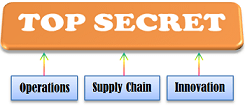
Innovating in secret

Apple’s private supply chain

Three traits of Steve Jobs’ success with Apple that stand out are attention to detail, constant feedback and secrecy around its famed product unveiling. Apple is known to maintain pre-launch secrecy of its products going as far as placing electronic monitors to track it’s yet to be released products across its supply chain. So the company, shipping it’s yet to be released products in tomato boxes to avoid detection is not surprising. Apple even took its fixation with secrecy to the courts. The secrecy culture began with the release of its first Macintosh. Competitors like Microsoft and Sony already had information about it before its launch.

When Jobs walked out with an envelope in hand during an Apple keynote, not many suspected that it would contain the ultra-thin MacBook Air. The surprise and wow on the faces of the audience was a moment to capture. Apple is reportedly working on the iWatch and could also announce Apple Television in future.

Nike’s secret labs

Reportedly, Nike has a secretive lab at its headquarters in Oregon known as the Sparq performance center. Other Nike’s mysterious R&D labs are ‘Zoo’ and the ‘Innovation Kitchen’. The idea behind such secretive labs is simple. Nike does not want details of its R&D leaked out. No photos should be clicked in these highly restricted areas where not many employees have access.

Google’s secret projects

Google also has its well-known ‘Google X lab’ to work on secret projects like space elevators, driver-less cars and Google Glass. Though the projects are not secret anymore with the company releasing information via various channels, the idea is to fuel public perception and foster an internal culture. But you just might not know the next big idea coming out of the secret lab.


Boomerang CEOs aka Founder Recall

June 5, 2013

I’ll be back

You have heard about product recalls. Every company (from toy manufacturers like Mattel to automobile companies like Toyota to food product manufacturers) recalls its product or takes corrective action for its services, sometime or the other during its lifetime. Some researchers suggest that each year more than 2,500 product recalls occur in the U.S. alone. The idea is to protect the reputation of the company (which is committed to safe practices) and avoid fallout with the customer.

The trend nowadays has been towards recalling the founders or CEOs who have performed brilliantly in the past and left the company. Of course the anticipation is that the founder or returning CEO will be able to affect a turnaround of sorts at the troubled company. The idea here again (as with a product recall) is to protect the company’s failing reputation and avoid losing customers.

Returning CEOs are known as boomerang CEOs

A Back to the Future approach

A common factor among companies recalling their CEOs is the preference for insiders who know the working of the company and more importantly, the industry in which they operate. They have had a successful track record at running the company and know how to respond to a challenging situation i.e. they already have CEO-level experience.

Comeback CEOs

CEOs or founders who return to the company are commonly being referred to as ‘Boomerang CEOs’. Let us take a look at some of them –

Return of Steve Luczo at Seagate

In 2009, Steve Luczo returned to Seagate Technology Inc., a data storage company, as CEO replacing Bill Watkins. Earlier, he was CEO from 1998 to 2004. In 2012, Fortune Magazine named him one of the Top 50 Businesspersons of the Year for turning around the company. Seagate was struggling with declining market share, rising costs, and massive debt. The company’s market value was less than $1.5 billion at the time of hiring Luczo. In 2007, an attempt to organize the company into business units had failed. When he came back, Luczo corrected this by overhauling the entire management team and reorganizing the company back to a functional structure. Shares rose from mere USD 5 in 2009 to USD 37 in three to four years later.

Lafley’s return to P&G

In May 2013, P&G, the world’s largest consumer product maker replaced its CEO Robert McDonald with Alan George Lafley. Lafley re-joined P&G as President and Chairman. Earlier, Lafley had been CEO with the company from 2000 to 2009. Lafley’s job is to improve sales of products, bring in new products and cut costs.

Mike Ullman’s return at J.C. Penney

Myron Ullman, ran J.C. Penney Co., the retailer from 2004 to 2011. In February 2012, he was replaced by Apple’s Ron Johnson. Johnson’s strategy “everyday low pricing” did not work as sales dipped $4.3 billion, with a loss of almost $1 billion. Johnson had dropped several brands, sales initiatives and coupons. By April 2013, Ullman was back as CEO. Ullman immediately promised bringing back three or four of private label brands dropped earlier by his predecessor.

Narayan Murthy’s return to Infosys

In May 2013, Infosys, an IT leader from India recalled its founder Narayan Murthy as Chairman. Infosys was clearly struggling in changing market conditions as competitor Cognizant displaced it from the second spot in the IT market in India.

Founders Dell, Schultz and Page return

Other famous leaders and founders who returned to their companies include Michael Dell to Dell Inc. in 2007, Howard Schultz to Starbucks in 2008 and Larry Page to Google in 2011. Howard Schultz was CEO from 1987 to 2000. Starbucks shares rose from USD 20 when Schultz returned in 2008 to around USD 58 in 2013. On his return as CEO, Larry Page immediately carried out a major reorganization of his management team in order to eliminate bureaucracy and lobbying while stepping up innovation.

Comeback King, Steve Jobs at Apple

But, the entire comeback CEOs would look to emulate charismatic leader Steve Jobs, founder of Apple. He was ousted from the company in 1985 in a power struggle. He became CEO again in 1997 and turned Apple into an iconic global brand.

How companies listen to their customers

June 3, 2013

Using market input

Customer Listening in action

Any company that uses market input to tweak its product offerings is making a wise decision. In other words, being committed to solve the customers’ problems and customizing product offerings is a must. But how do companies do it. A good starting point is identifying what customers are really trying to achieve. A narrow-minded approach would limit a supplier to specific products the customer is buying. A research has found that customers quietly dump the suppliers without complaining (TARP research has found a 1 to 26 ratio for every customer who complains to those who do not). So it is very important to ask the customer what they want and get their feedback on various issues they are facing. Among many ways to listen to the customer like surveys, standard forms, observation, interacting at point of sale, net promoter score or via social media, a combination of all might work to the best advantage. There is no one best solution.

Let us see how some companies e.g. Apple, HP and Xerox are listening to their customers.

Does Apple listen to its customers?

Quote
“I only wish I could find an institute that teaches people how to listen. Business people need to listen at least as much as they need to talk. Too many people fail to realize that real communication goes in both directions.”
— Lee Iacocca, Former CEO Chrysler Corporation
Unquote
“A lot of times, people don’t know what they want until you show it to them.”
— Steve Jobs, Apple

The above two quotes made by two great leaders contrast each other w.r.t listening to the customer. You may ask, “So does Apple not listen to its customers?” The answer, it does, perhaps in its own unique way. In their book, authors Fred Reichheld with Rob Markey, describe in detail how Apple advocates the Net Promoter Score (NPS) for methodically listening to customers. The NPS concept tracks promoters (i.e. those who will recommend the product or service to a friend or a co-worker) and detractors on a 0-10 point scale.

NPS is used for daily management of Apple’s stores and evaluate store performance and correspondingly make improvements. A central NPS team is responsible for analyzing customer feedback from all the stores. The analysis reveals reasons for a promoter’s keenness or a detractors disinterest as per the NPS concept. The store managers then call every detractor within 24 hours as findings suggest that they purchase significantly more Apple products and services than the others. An hour spent on calling detractors was fetching more revenue with additional sales.

How HP listens to its customers?

Procter & Gamble (P&G) wanted to digitize and use technology for business decisions. In 2003, HP began a 10 year contract to manage P&G’s internal tech services. In 2012, when the contract came up for renewal, P&G wanted to make its IT operations stronger and work with offerings from many vendors. HP was open to the deal. So in cases where HP’s hardware or offering did not meet P&G’s requirement, HP was willing to work with other vendors to fill the gap. HP and P&G realized that this would make the IT operation stronger. As a result P&G extended the contract for five more years and a 50% increase in annual value.

HP researchers are also known to visit the customer location and film the business process for a day so as to suggest how HP could help them. HP is also known for its “Day in the Life of a Customer” concept.

How Xerox listens to its customers?

Xerox listens to its customers via Relationship Surveys, Transactional Surveys and social media. It uses facilities like Real-time alerts and processes involving Lean Six Sigma techniques to addresses customers’ requirements. The company has programs like the ‘Xerox Corporate Focus Executive Program’ to build relationships with its top 100 accounts. In another program, 36 company officers take turns to be “Customer Care Officer of the Day” to listen to the customers and solve their problems.

Xerox conducts business live events across the country like the “Xerox Focus Forward”. These events are aimed to connecting Xerox with current and future Xerox customers and explore opportunities. The event shows its customers how Xerox can help solve real business problems.

Developers as Happiness Engineers

May 30, 2013

It is in my genes to code

A majority of software developers take pride in the software they code. Put them in a support job function and they seem lost and highly disinterested. They believe, it is in their genes to code and a support job would be menial and below their dignity. This is particularly true in emerging countries, where a call centre employee would be looked down upon by someone in an IT/software job and even an IT networking job function for that matter. After all, they earn probably double the salary or more and enjoy more prestige in the society.

‘Give me a development project, I have so much experience’

Consider this scenario. A global IT company has bagged a project to support an important client’s applications and the project is worth millions. The company has put some of its best application developers to support. Within a few days of hiring the resources for the project, people managers are busy, not with project work but concerns from their resources allocated for the project. Typically, an application developer complains about the project being a support one which does not require much development work. They are concerned about their coding experience going to waste. HR managers hear this often – “Other application developers are coding ground breaking applications aka changing the world and here we are stuck providing mere support, application fixes and debugging.”

No, doing support is not a crime or punishment

Well consider this. The thing that software developers should hate the most is that they rarely communicated with the end users, the ones who actually use their application. The developers are given a list of requirements, stated what is expected and that is it. In the end, they never find out whether their work meets the requirements of the actual end users. They also never get a chance to find out from the end users about how to improve the application or get an honest feedback albeit appreciation on the work.

The whole point of writing code is not ‘we make, you take’

What is the whole point of writing software? It is to develop something useful that adds value to the life of some or many. A ‘we make, you take’ approach leaves the customers ignored and passive. If you do not communicate with the people who use your output, you are losing out on an overall learning or growth opportunity. Sadly, many developers take a negative approach and do not indulge in anything that distracts them from the love of their life – coding. However, side-stepping support totally is a big blunder.

Engineers in the pursuit of happiness

Many organizations do a good job of listening to their customers. But a gap exists because only the sales team is involved and the developers are not involved. These developers are the very people who actually make the end product and their insight would be invaluable. Well, how do you involve the developers? Take the example of Automattic, the company behind the famous content management system – WordPress. Every new hire that joins Automattic, initially finishes three weeks of support before moving on to coding or any other role. The three weeks support role is mandatory for everyone irrespective of the role in which they are joining. Why so? It forces the developer or the new hire to see software through the customers’ eyes. By directly communicating with the actual users of the software, the company can find out what the problems are in the software and what one can do to streamline it. The company recognizes that their software and services are not perfect. In fact, they have job positions titled – ‘Happiness Engineers’. They believe when things go wrong people are not wary about asking for help. Happiness Engineers help those people and it is their passion to make products more understandable to the people who use them and more importantly to the company. A developer in that role can do wonders.

Developers in support role

Management Gurus and what they are known for

January 20, 2013

Management Gurus and their specialtyThere are many business leaders and management thinkers who have contributed and introduced various management theories or terms over the years. Here is a partial list of Business Strategy gurus or Management leaders and the term they coined or the strategy/management concept they are known for.

Guru Management/Strategy Concept
Abraham Maslow Hierarchy theory of motivation
Adrian J Slywotzky Value migration
Alfred DuPont Chandler Relationship between strategy and structure
Andrew Grove Strategic Inflection Point
Baybrooke and Lindblom Strategic decision-making process
Bennett G – Stewart EVA (Economic Vale Added)
C K Prahalad and Gary Hamel Core Competence, Bottom-of-the-pyramid
Charles Handy Virtual Organization, Outsourcing
Chester Barnard Communication and shared values in organizations
Chris Argyris Learning – single-loop and double-loop learning
Chris Zook and James Allen Adjacencies
Christopher A Bartlett Globalisation, Competition across borders
Clayton M Christensen Disruptive innovation
Cliff Bowman Relative price
David Yoffie Judo Strategy
Douglas McGregor Theory X and Theory Y
Elton Mayo and Fritz Roethlisberger Hawthorne experiments
Frederick Herzberg Two-factor theory of job satisfaction
George Yip Counterparry
Henri Fayol Problems of organizational structure
Henry Mintzberg Strategic Planning
Igor Ansoff Corporate Strategic Planning, popularizing SWOT analysis
James Brian Quinn Logical incrementalism
James C Collins and Jerry I Porras Big Hairy Audacious Goals (BHAGS)
James Tobin Q-theory
James Utterback Innovation
Jeffrey Pfeffer and Robert Sutton Knowing-Doing Gap
Jim Collins Hedgehog Principle
Kaplan and Norton Balanced Score-Card
Kenichi Ohmae Strategy, Globalization
Kurt Lewin Force Field Analysis
Laurence Peter Peter Principle
Major Edward A. Murphy, Jr. Murphy’s law
Mary Parker Follett Collaborative and participative management and cross-functional problem solving
Michael Cusumano Strategic management of tech companies, Platform leadership and knowledge transfer across projects
Michael E Porter Five Forces Model, Value Chain
Morton Grodzins Tipping Point
Pascale and Athos McKinsey 7-S Framework
Peter F Drucker Father of modern management
Paul Krugman New trade theory
Peter Senge Learning organization
Ray Noorda Co-opetition
Rita Gunther McGrath and Ian C. MacMillan Discovery Driven Planning
Robert S McNamara Systems analysis
Ronald Coase Transaction costs and Social Cost
Russell Ackoff Strategic/Corporate Planning
Spender J C Strategic recipes
Stephen Covey Emotional Intelligence
Sumantra Ghoshal Globalisation, Competition across borders
Vijay Govindarajan Reverse Innovation, Strategic Cost Management
Vilfredo Pareto Pareto’s Principle
W Chan Kim and Renee Mauborgne Blue Ocean Strategy
William Edwards Deming Total Quality Management

Ticket pricing strategy at the London 2012 Olympic Games

July 10, 2012

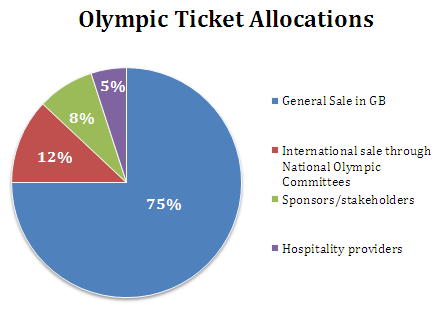
The organizing committee (London Organizing Committee of the Olympic Games and Paralympic Games – “Locog”) of the London 2012 Olympic Games had a unique challenge before them. They had to price over 8.8 million tickets (of which 75% would go on sale to the public) for 26 sporting events and ensure impartial affordable access to everyone planning to attend the event. What was more challenging was the demand uncertainty, as they had to price all events more than a year and a half in advance (March 2011) of the Games, set to begin on 27 July 2012. The London 2012 Chairman, Lord Coe termed it the “the daddy of all ticket strategies”.

Olympic Ticket Allocation

Three principles of the ticketing strategy:

  1. Tickets need to be affordable and accessible to as many people as possible.
  2. Tickets are an important revenue stream to fund the games and
  3. Fill the venues for all events.

Some important elements of the ticket pricing strategy:

  • 90% of the public tickets would be priced at £100 or less, 66% at £50 or less, while 2.5m tickets would be priced at £20 or less.
  • Increasing the number of pricing tiers to keep prices low while maintaining revenues. However, the tiers did not have a fixed number of seats. Those who bought tickets at a higher price were guaranteed better views of the sport. Demand at various price points helped ascertain the number of seats.
  • In all, there were about 26 different pricing plans with details on how to promote and the target audience.
  • Pay-your-age pricing plan for youngsters. There were approximately 1.3m tickets for youngsters 16 years or under at the start of the games who could pay their age in pounds.
  • Discounted tickets to those over 60 years of age. (flat £16 price)
  • A Ticketshare scheme (120,000 free tickets – ‘prestige tickets’) was put in place wherein thousands of schoolchildren would get tickets.
  • High and low, price points for the opening ceremony.
  • No free tickets policy to prevent any public outrage.
  • No bundling of tickets for popular and less popular sports. In the past, this strategy had been used at previous Olympics to increase sale of tickets sales and popularizing less known sports. However, ticket holders typically ignored the less popular sport.
  • Public Transport was included in the ticket price plan to reduce traffic and increase participation.

By January 2012, 3.8m tickets had been sold. Let the games begin!

Pricing Strategy – A few pointers

May 30, 2012

Is The Price Right?

Many companies face this question – What should they charge for their products? Right pricing has always been a tussle between the seller and buyer. Traditionally, brands set the price based on competitors offering, market conditions (supply/demand), ROI etc. Then came along value-based pricing wherein a customer would pay a price that would reflect a product’s true value. However, marketers would argue that such a strategy is subjective because value means different things to different consumers. A discount strategy would probably work better instead. In addition, factors like loss aversion play a role – the value of a few cents is much higher when it is deducted rather than added to the bill value.

Pricing Strategy - A few pointers

Case in point

Starbucks charges its customers 10 cents for every paper cup they use. If the customers bring a reusable travel mug, they get a 10-cent discount on any Starbucks beverage. An ideal pricing strategy can be – set one default price and charge 10 cents extra for the paper cup instead of offering a discount for getting a mug.

In January 2011, jcpenney announced its “Fair and Square” pricing strategy. As per the new strategy, the company removed frequent deep-discount sales it had been offering and instead reduced the base price of all items by about 40%. However, the new pricing strategy did not work as in a few months the store traffic declined by 10% and sales by more than 20%. To the customer the ‘fair’ (low) price feels like cheap product whereas a higher priced product offered at a discount appears to be of higher value. Similarly, a few years back Macy’s had reduced the number of coupons it offered to its customers. However, within a year, it restored the coupons, as it realized that consumers preferred them.

In 1992, American Airlines had announced a simplified pricing system (four kinds of fares instead of 16). The pricing strategy was adopted to save $25 million annually by reducing administrative burden with so many fare types. However, in six months American Airlines withdrew the new pricing plan admitting that it was a failure. Competitors were easily undercutting their simple fares.

In April 2012, P&G reported that its sales increased 3% in the quarter. Its competitors, Unilever PLC and Colgate-Palmolive reported sales increase of 8.5% and 6.5% respectively. The problem lay in P&G’s price war strategy to defend market share and not profits. P&G managers reduced prices to hold market share. This resulted in lower margins for the company. In the end, aggressive pricing strategies should be combined with innovation. P&G’s rivals innovated better in many product categories and were more successful.

In September 2011, Bank of America announced that it would charge 5USD per month as debit card fees. Customers were not happy with this decision and by end of the year the number of closed accounts increased by 20% as compared to a year earlier. In July 2011, Netflix increased its prices by 60% for DVD and video streaming rentals. Customers did not like the unjust move and many users cancelled the service.

Points to ponder

  • Do not price the product too low thinking that customers want cheaper products. The customer might consider it of low value.
  • Do not price the product too high unless it is well differentiated or unique otherwise the competition with similar offering will win.
  • Know your customer and what he/she wants. If the majority customer is in the middle-income group and prefer discounts, price accordingly. Similarly, if the majority customer is high-income group, then they might not prefer cheap products considering them to be of inferior value.
  • If the customers know the cost, they set the price.

The Business Model A/B Test

April 25, 2012

Will the business idea work?

A business idea has to be viable to succeed. It has to pass both the logic test (does it make sense, add unique value?) and the economic test (can it work profitably?). If it passes the one test but fails the other test then the business is bound to fail. There are various quantitative and qualitative market research reports, focus group results etc. to aid the feasibility of a business model. There is also the narrative and the numbers test. However, until a business is set up in the market; it is very difficult to know if it will really succeed.

The real world lesson

On paper, it is very easy to formulate a business idea, estimate revenue and costs, write up profitability and future cash flow reports. However, actual market experience alone will give the correct picture. It may also take numerous iterations in the real world to find a business model that works. Therefore, does this mean that a detailed business plan is a waste of time and that businesses should just take the plunge right away? Certainly not. A good approach would be develop a unique idea, prototype quickly and then move to the market even faster. The key is to learn from failure and rapidly iterate to adapt the business model.
Testing your business model

Testing your business model

Many successful businesses have demonstrated how you can test your business model before you can take the plunge.

Apple specialty stores

Steve Jobs was not happy with the placement, sales support and customer service Apple products was receiving in the traditional consumer electronic retail channels. He realized that buying the product was an important element of the overall customer experience. He wanted to build Apple specialty stores that would improve the buying experience for the customers. However, Jobs did not go out and set up a store right away. In fact, the first store was a prototype (design studio) set up right inside the Apple campus to test the business model. A key learning for Steve Jobs here was that it was not about a layout with grouping products, but what the customer could do with Apple products. When Jobs was comfortable with the arrangement after several iterations, the company set up its first specialty store in the real world.

Microsoft’s Retail Experience Center

Microsoft is using a 20,000 square-foot facility called the Retail Experience Center (REC) to educate third party retailer partners like Best Buy and Wal-Mart on the New Microsoft experience and how it envisions people will be using its technology. Microsoft has also created a fictional store chain called Contoso, to demonstrate how its products can be displayed well online.

P&G – India tailored Business Model

Gillette developed a new razor for India after testing it on Indian men studying at MIT. Though the test was successful, the product was a failure when launched in India. To identify the cause of failure, P&G sent over a team to India to study the shopping and living habits of Indian customers. They found that lack of running water or a comfortable bathroom to shave in were the reasons Indian consumers avoided the P&G razor. P&G developed a low-cost, well-designed and affordable product with 80% less parts. The product was successful. However, P&G did not stop there; it developed an India-tailored business model with local manufacturing and distribution. P&G plans to introduce the product to other emerging countries and developed countries like the U.S. in the future.

The TOP program at Philips

April 5, 2012

Trouble at Philips

In the 1990s, Netherlands-based Royal Philips Electronics (Philips) was performing poorly. By the end of the 90s decade Philips was nearly bankrupt with record losses. Innovations like the rotary head shaver, compact cassette and the CD, DVD formats had come from the Philips stable and it was hard to believe that the company was going down. Though it was Europe’s largest electronics company, it was not making profits from its consumer-electronics division. U.S. sales were disappointing as well.

The restructuring

In April 2001, Gerard Kleisterlee took over as Philips’ President. He knew it was time for some bold decisions if he had to revive the famous company. He immediately took routine restructuring steps like selling non-core businesses, outsourcing unprofitable production and centralizing major functions like HR and payroll were completed. However, he knew this was not the long-term solution.

‘Towards One Philips’ (TOP) program

In 2001, Kleisterlee launched the ‘Towards One Philips’ (TOP) program for company-wide efficiency, integration and synergy-creation. Under the program, the business structure was simplified from 14 product divisions down to five product divisions.

Strategic Conversations

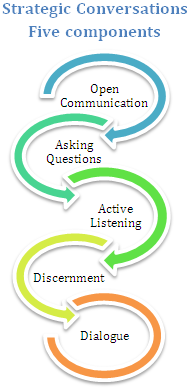
Technology and tactics were not the answer. Kleisterlee believed talking was the key as there was minimal communication among the six departments the business was divided into. He sponsored “strategic conversations”, a move to develop assurance, kindle cooperation across departments, and kindle speed new product introduction to market. As a first step to enable strategic conversations, he identified four key themes that Philips could be successful in – display, storage, connectivity, and digital video processing. Next, he invited everyone who could contribute irrespective of rank to one-day summit talks on the four themes. The idea was to establish dialogue to begin a road map and strategy for key projects by exchanging views and debating various settings.

Five components of Strategic Conversation

The benefits

In March 2003, Kleisterlee announced at a shareholder meeting that the company had identified over 600 projects with a total potential saving of over EUR 500 million as part of the ‘Towards One Philips’ (TOP) program.

The benefits were evident as it brought about a clear culture change. With increased collaboration among product divisions there was increased knowledge sharing. Because of the talks, the management realized that winning in optical storage implied winning in the DVD-recorder market.

Many projects, which required a unified effort of various divisions, were created. E.g., ‘Ambient Experience’ was a joint effort of Philips’ Medical, Lighting, Consumer Electronics and Design divisions. New technologies like ‘Connected Home’ were also developed as part of the TOP initiative.

Best Buy’s radical experiment (ROWE) in workplace flexibility

April 2, 2012

ROWE your own boat – Work from anywhere

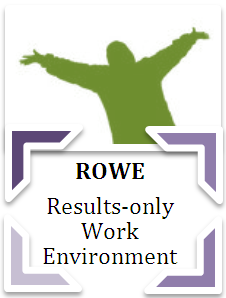
In 2005/6, Best Buy, the leading electronics retailer introduced a unique program developed by its employees called ROWE. ROWE stands for “results-only work environment” and the goal of the corporate culture initiative was simple – judge performance based on output not on the number of hours spent at the office. Traditionally, many HR departments in companies viewed consistent attendance at office as good productivity. ROWE on the other hand allowed employees to make their own work-life decisions.

Best Buy’s idea was not original in the sense that a few other companies like IBM and AT&T were already practicing the concept of allowing employees to work anywhere they want. However, Best Buy transformed its culture radically, practiced it more passionately and made the practice more rampant. The CEO, Brad Anderson even formed a subsidiary CultureRx to sign in other companies.

Best Buy's ROWE initiative

Features of Best Buy’s ROWE program

  1. No timetables.
  2. No compulsory meetings.
  3. No impression-management hustles.
  4. Work no longer a place to go. Work is something to be done.
  5. Performance would be based on output, not hours.

How it all began? – A private management experiment

In 2003, two Best Buy HR employees – Jody Thompson and Cali Ressler came together to introduce the idea quietly. They agreed that a top-down approach would not work. The strict work@office regimen, meetings etc. at Best Buy were increasing employee stress levels and hindering the expansion of the company. They convinced two managers to join the experiment. The two managers then took meetings on boat trips or biking trips. There were no scheduled or mandatory meetings, performance appraisal was based on output instead of time put in and ROWE participants did not have to be physically in office. The idea soon spread in various employee circles and to the top management. Traditional managers were critical and did not understand how working while holidaying would solve the work life balance. However, ROWE spread across the company and eventually the CEO was informed on the 13 commandments of the ROWE campaign. By 2008, all headquarters employees (around 4,000) were working in ROWE.

ROWE commandments examples:

  • Nobody talks about how many hours they work.
  • Every meeting is optional.
  • It’s O.K. to take a nap on a Tuesday afternoon, grocery shop on Wednesday morning, or catch a movie on Thursday afternoon.

The results were amazing. In some departments that switched to ROWE, productivity rose by an average of 35% and voluntary turnover decreased by 52-90%. Today, some other ROWE approved companies include GAP, Banana Republic and ripple among many others.

1 2 3 4›»

Recent Posts

  • Operational Secrecy – Innovating in “secret”
  • Boomerang CEOs aka Founder Recall
  • How companies listen to their customers
  • Developers as Happiness Engineers
  • Management Gurus and what they are known for

Recent Comments

  • MKJ on How to write a case study?

Categories

  • Articles
  • Business Ethics
  • Business Strategy
  • Dell
  • Entry Strategy
  • GE
  • HP
  • HR Case Studies (HRM)
  • IBM
  • Innovation Management
  • IT Cases
  • Jack Welch
  • Leadership and Entrepreneurship
  • Marketing Management
  • Mergers and Acquisitions
  • Nokia
  • Oprah Winfrey
  • Retail
  • Supply Chain Management (SCM)
  • SWOT Analysis
  • Tesco
  • Turnaround Strategy
  • Uncategorized
Business & Management Case Studies
  • Privacy Policy
  • FAQ
  • RSS
  • About
  • Helpdesk
© Business & Management Case Studies 2026

↑ Back to top