Business & Management Case Studies
  • Case Studies
  • Articles
  • About
  • FAQ

Companies and the Rural Push

November 17, 2011

With a faltering economy, many companies are sending their sales force into rural areas to increase sales and market share. MNCs like P&G, Unilever and Nestle are not only targeting the tier-1 rich consumers but also the very poor. Here is a look at the rural push by various companies:

Unilever in Pakistan – The Guddi Baji Program

Unilever, world’s second-largest consumer-goods company is aggressively pushing its beauty products in rural villages in Pakistan through Guddi Baji program. It hires beauty specialists and village women as sales representatives who understand rural women. They provide them with samples and equipment stocked in vans.

Hindustan Unilever in India

In 2011, Hindustan Unilever (HUL) was in talks with leading telecom firms and banks to create a joint distribution model to reach out to a wider rural market.

Colgate-Palmolive in Pakistan – 5000 to 15000 villages

Colgate-Palmolive, the world’s largest toothpaste maker is moving away from Pakistan cities by tripling the number of villages where its products like Colgate toothpaste are available.

ITC in India – Extending rural push

To extend the rural push, ITC collaborated with companies like Maruti Suzuki, Nokia and State Bank India (SBI) to connect with rural consumers. Rural consumers could thus get a chance to mingle with different companies and organizations under the ITC e-Choupal umbrella (rural distribution channel). The idea is to add more products to its rural distribution channels to increase awareness of its products and brands among rural customers. By 2011, ITC had around 6,500 e-Choupals in 50,000 villages across India.

Mahindra & Mahindra (M&M) – Rural Sales Drive

M&M, the car-maker increased its focus on the rural and semi-urban markets and gained by strengthening its after sales network in all districts of India.

Procter & Gamble (P&G) in China

To cater to poor people in developing markets, P&G introduced the “$2 a Day” project in China. P&G plans to target consumers with average income of $2. It calls them the “$2 a day” consumer. P&G’s team involves mostly technical people than market researchers who attempt to study and learn how best to develop products for the poor. The team devotes time by visiting homes in China and other countries like Brazil, and India.

U.S. Telecoms – Closing the rural divide

In July 2011, six major U.S. broadband companies (AT&T, CenturyLink, FairPoint, Frontier, Verizon and Little Rock-based Windstream) made a proposal to the FCC to speed broadband deployment to rural areas. There are more than 4 million Americans living in rural areas.

Coca-Cola – The ‘parivartan’ program – Training small town retailers

Coke’s new strategy involves training retailers (around 6,000 of them) in a program launched by the Coca-Cola University. [In 2007, the company launched Coca-Cola University — a virtual, global university for all learning and capability-building activities.]
The company calls this the “parivartan” program (meaning “Change” in English). Read More on Coke’s Rural push.

Pepsico – Affordable and accessible breakfast cereals in rural India

PepsiCo is targetting smaller cities in India for its breakfast cereals – like the Quaker Oats brand. The company wants to keeps the product affordable (@ Rs 5 for a bowl of Oats) and wants to educate the customer its health benefits in tier I and tier II cities of India.

Amazon – Amazing Facts

November 15, 2011

  • Amazon’s original name was Cadabra.
  • In the 1990s Amazon’s slogan was “Earth’s largest bookstore”.
  • In 2006, the company introduced an online TV and movie store.
  • Kindle e- book store was launched in 2007, and the MP3 digital music store in 2008.
  • Around 800 hardware and software engineers work at Amazon’s devices division in Cupertino, California.
  • Jef Bezos, founder of Amazon believes that the company is still in its infancy and hence the headquarters is named ‘Day one south’
  • The Lab126 Project – The 1 stands for a, the 26 for z.
  • The personalization team at Amazon are referred to as P13N – the 13 as per the count of letters in the word “personalization.”
  • The original Kindle was code-named “Fiona” after a character in Neal Stephenson’s futuristic novel “The Diamond Age”.
  • The latest in the Kindle series, the Kindle Fire had an internal code name – “Otter”.
  • n 2010, the average revenue per user (ARPU) for Amazon was US$189. This figure was eight times higher than Google’s ARPU of $24 and about forty times higher than Facebook ($4). Ebay had an ARPU of $39 while Yahoo had $8.
  • In 2011, its revenues were set to touch $50 billion in sales. To put that into perspective, Wal-Mart took around 33 years to match the figure (in double the time).
  • In a span of five years from the start, Amazon had revenues of $2.8 billion (1995-2000) compared to eBay’s $0.4 billion (1995-2000) and Google’s $1.5 billion (1998-2003).
  • In 2011, Amazon processed 35 orders per second during the holiday season.
  • in 2007, Amazon’s sales increased by 38% to $15 billion, but its profit more than doubled to $476 million.

Twittering Profits – Transformational business impact

November 4, 2011

Low-cost customer service

In 2008, Gartner identified Twitter as a disruptive technology that would change business in the coming years. According to some estimates, there are around 3 million users on twitter. Both large corporations and small businesses use the low-cost free micro blogging service for various purposes including gathering customer data, responding to customer grievances and even brand promotion. Many companies have official twitter accounts and even encourage employees to use it e.g., more than 400 Zappos employees use Twitter, Dell has 20 official Twitter accounts.

How companies are using Twitter?

Tracking Inventory – Can’t find a product at the store? Just tweet about it

In 2010, Indian FMCG Company Parle Agro used Twitter to track inventory. Customers and retailers could inform the company via Twitter whether there was enough stock of its baked wheat snack brand Hippo in their neighborhood stores. The results were good with the company receiving tweets from 25 cities regarding Hippo’s distribution and boosting sales by approx. 75%. With Hippo’s mass-distribution to five lakh retail outlets, Twitter served the company equaling almost half of Parle Agro’s foods sales team.

Consumer Complaints/Service – Instant action

Many companies monitor tweets by customers and respond immediately, e.g. Kingfisher Airlines Ltd. responded to a customer complaint on twitter on not finding a lounge at the airport within 15 minutes. ICICI Bank refills its ATMs when a customer complains by tweeting about it. JetBlue provides Twitter based customer service, even displaying the employee on duty at any time.

Useful brand-monitoring and corporate identity tool

Zappos looks at twitter as an opportunity to network with customers and improve its brand image. Zappos CEO Tweets many times in a day has many followers and around 400 employees use twitter to nurture a company culture. Samsung’s Twitter account focuses on mobile phones and product news.

Collecting Data, Focus groups

Many companies tweet about their product launches and get instant feedback on various issues. The user segmentation (usually gathered from the bios, profile of the twitter users) helps elicit opinion from the right target audience. Procter & Gamble (P&G) uses feedback on the quality of their products launched on twitter. Starbucks also tweets about new offers and shares details with its twitter followers. Wal-Mart uses Twitter to make a better shopping experience for its customers.

Nokia’s shadow program

November 2, 2011

Shadowing by colleagues

Colleagues follow every move of around 30 of Nokia India’s top management leaders for about a week. They observe what they do, how they do and learn from them. The management team selects top 30 Nokia leaders, not based on hierarchy but from any level who typify Nokia’s four values – PAVE – Passion for Innovation, Achieving Together, Very Human and Engaging You.

A unique HR program at the workplace

The shadow program introduced by Nokia India is a hit among Nokia’s other offices across the globe. While it is common for new recruits to follow colleagues as part of the induction program, the shadow program is unique in the sense that experienced colleagues follow leaders who live the company values. If the leader travels to a remote location, then the shadower follows suit. The travel expenses are not a constraint.

Unique Learning Benefits

Due to the informal network creation, both the leader and shadower get an exposure to insights and learning from other departments that would not have been possible otherwise. At the end of the shadowing, the shadowers write down their experience. The written information is then circulated among the top 30 leaders and contributes to improving their leadership skills as well.

Having leadership participate in such shadow programmes and share learning in the workplace, is a symbolic sign of leaders giving way to light (colleagues) where once they cast a shadow (not in a bad sense).

The Nissan Way – Power from within

October 12, 2011

Nissan, the Japanese automaker has a very simple management thinking known as the ‘The Nissan Way’. According to the Nissan way, the customer is prime focus, value creation provides the impetus and success is measured in terms of profit.

Nissan conducts various Nissan Way workshops where its business leaders share knowledge and educate fellow employees. The Nissan Way is different from the Nissan Production Way (NPW), it introduced in 1994. A document detailing ‘The Nissan Way’ is available in eight languages for its employees worldwide.

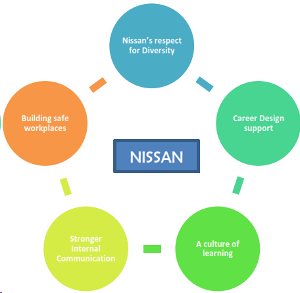
Five enablers to the Nissan way

Five elements of the Nissan Way

Nissan’s respect for Diversity

In 2004, Nissan formed the Diversity Development Office (DDO) and established a diversity steering committee to foster diversity. The DDO was especially useful given the cross-cultural nature of its alliance with Renault in 1999. With the DDO, Nissan could make full use of the women talent in the company (focusing on two key areas – women’s career development & work-life balance for employees) and create higher value. Nissan holds diversity workshops and provides training to women as part of its managerial training program. Nissan was recognized it’s Women in the Driver’s Seat initiative in 2008. By 2010, Nissan had doubled its percentage of female car-life advisors and technical advisors as compared to 2003.

Career Design support

Employees design their own career in consultation with their supervisors whom they meet twice a year. Supervisors evaluate their performance and discuss aspirations & goals. Japanese employees have two options to take new roles – Shift Career System (to apply for positions in their own department and work practice) and the Open Entry System (to apply for openly advertised positions). Nissan also developed the Expert Leader System to develop specific skills in a wide range of technical and nontechnical domains. The expert leaders in turn, train other employees by sharing knowledge during seminars and using other communication channels available within the company.

Culture of learning

Nissan recognizes the importance of learning for its employees. Its initiatives like the Learning Navigation system on its intranet and its Nissan Learning Center Management Institute provide many opportunities for learning.

Stronger Internal Communication

To promote communication and information sharing, Nissan has in place tools like the corporate intranet system called WIN (Workforce Integration @ Nissan). The company also conducts various surveys to get employee feedback. Newsletters, opinion-exchange meetings and in-house video broadcasts help information sharing across various production facilities. In 2009, Nissan began N-Square, an internal social networking service in Japanese (English in 2010) for employees.

Building safe workplaces

Nissan values human resources as its most valuable assets and employs a single unified set of safety standards globally. Nissan engages in human-friendly production and uses practices like ‘strike zone’ approach. In 2005, the company introduced Advantage EAP (Employee Assistance Program), a mental healthcare program, to take care of the mental health of its employees.

Japanese M&A in foreign markets – second-largest acquirers in the world in 2011

September 30, 2011

Importance of expanding overseas and competing on a global scale

In 2010, China had overtaken Japan as the as the world’s second-largest economy as Japan struggled with a stagnant economy. In March 2011, the quake & tsunami disaster disrupted factory production and shook Japanese companies. Earlier, they had focused only on the domestic market and had a reputation of being slow to expand in foreign markets. Now they have realized the importance of expanding overseas and competing globally.

The second-largest acquirers in the world in 2011

In 2011 YTD (through August 31), the number of global M&A deals stood at 617 and were valued at $1.8 trillion. According to Thomson-Reuter, there have been 380 Japanese M&A transactions across the border.

According to Dealogic, in 2010 Japanese firms spent $34.34 billion in global acquisitions. This year until date, they have spent more than $52.5 billion in global acquisitions. This makes them the second-largest acquirers globally this year (U.S. ranks one). A strong yen has helped them though it makes Japanese exports less competitive overseas. In 2008, they had spent a record $68 billion and are on way to exceed that figure.

Are Japan’s Foreign Acquisitions Right?

A Nikkei article reported that of all listed companies (reporting on March 31, 2011) had earned 80% of operating profits overseas. While foreign acquisitions may make the Japanese proud, many analysts think that Japanese firms must be more competitive through domestic consolidation and not be hasty to make acquisitions abroad. Analysts also think that Japanese firms are paying more than the actual valuation.

However, acquisition of U.S. companies will quicken the implementation of internationally recognized best governance practices and help focus on return on investment, which the Japanese give second preference over harmony and lifelong employment.

Japanese firms going global with overseas acquisitions

A few Foreign Acquisitions by Japanese corporations
Japanese Company Acquired Industry Amount Details
Asahi Group Holdings Ltd. Independent Liquor Ltd. Brewery $1.27 billion One of New Zealand’s largest beer companies
Toshiba Landis & Gyr Electricity metering equipment $2.3 billion Century-old Landis+Gyr, a prominent smart metering firm
Takeda Pharmaceutical Takeda Pharmaceutical Drug maker $14 billion Biggest deal of the year

Co-opetition – When Apple and Microsoft struck a deal

September 29, 2011

Sleeping With the Enemy

On Aug. 6, 1997, at the Macworld conference in Boston Steve Jobs announced the unthinkable. He announced a strategic partnership with rival Microsoft. The surprised audience first clapped then booed when they realized what had just been announced. Earlier, Apple had sued Microsoft for patent infringement.

“Apple needs help from other partners … and relationships that are destructive are no help to anybody in this industry today…We have to let go of the notion that for Apple to win, Microsoft has to lose.”
– Steve Jobs at the Macworld conference in Boston in 1997.

In 1997, Apple was struggling and Steve Jobs had just returned to save the company. Apple had lost more than a billion dollars with little sales growth. Microsoft on the other hand was the market leader and had loads of cash.

The Strategic Deal – From enemies to ending all legal hostilities

Apple and Microsoft signed a broad five-year patent-licensing agreement ending the legal hostilities.

  • For five years, Microsoft would release an Apple (or Mac) version of its leading Office product in addition to the Windows version. Bill Gates had remarked that around 8 million Microsoft users were on the Apple platform and the Mac Office 98 was more advanced than even the one on the Windows platform as it utilized the unique capabilities of the Mac.
  • Microsoft would invest $150 million in Apple shares (non-voting) and not sell it for three years.
  • Internet Explorer would be the default browser on the Macintosh platform. When the audience reacted negatively, Steve also announced that they would ship other browsers as well and it was up to the user to set any browser as their default. He also acknowledged Internet explorer as a good browser at the time.
  • Apple and Microsoft would ensure that each of their versions of the Java programming language were compatible.

Who won in the end

Some call the deal a masterstroke from Steve Jobs and credit his leadership skills. Well, the numbers do not lie – 14 year after the deal in 2011, Apple is the most valuable company with market capitalization at approx. $375 billion and ahead of Microsoft’s market cap at approx. $210 billion.

Below is a video of Jobs’s 1997 keynote

Why online business in China will become the world’s largest by 2015?

August 9, 2011

A Boston Consulting Group report stated that by 2015, the yearly value of China’s e-commerce market would grow by four times to $305 billion to become the world’s largest. Many e-commerce enterprises that are famous globally have emerged in China. Here are a few factors responsible for the successful growth of e-commerce in China:

Internet Usage

The Chinese spend about 1 billion hours online each day and are younger (73% of China’s total online population is aged less than 35) than their western counterparts. This is more than double the daily total in the US. Cheaper internet and increasing disposable income contributes to higher spending power. China has an average connection speed of one mbps compared to its neighbor India’s 0.8 mbps.

% of Chinese population which shopped online
2006 3%
2009 8%
2012 19%

American E-Commerce does not work in China

“Foreign e-commerce companies should be acutely aware of the differences in China’s cultural, political, social, and economic development, and adapt to those differences.”
– Justin Ren, associate professor at the School of Management.

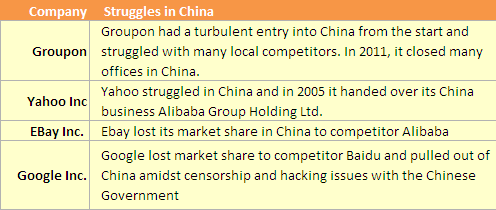
While American e-commerce firms have been successful in non-Chinese foreign markets, they have not fared that well in China. In 2004, Amazon bought a Chinese website to enter the China market but flopped. eBay spent around $400 million in China but could not capture even 10% of the market. Google had its own problems with the Chinese government over censorship and hacking scandals. Foreign firms hire Chinese mangers but the centralized management renders it ineffective. Moreover, website designs which work back home do not work in China. For example, Chinese websites are less about selling while eBay’s Chinese website emphasized low priced products and was similar to the design in the U.S. Therefore, even famous brands like Louis Vuitton, Levi Strauss, and Ray-Ban have teamed with the Chinese websites like Taobao to sell their goods.

Foreign Internet companies have long struggled in China

China’s Internet entrepreneurs

The Chinese online entrepreneurs’ drive to win & sheer hard work is unmatched. Many work part-time and study as well.

Filling voids than disrupting existing industries

Unlike the west, Chinese online businesses fill voids in market rather than disrupt existing industries. Moreover, offline businesses are less efficient.

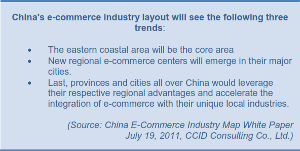
Three trends in Chinese Ecommerce industry

Apple’s Mindshare to Marketshare Retail strategy

May 23, 2011

Sony vs Apple

Almost a decade ago, Sony’s market value was seven times more than Apple’s market share. Today, the tables have turned and Apple’s market value is eleven times more than Sony’s market value. Apple had ended Sony’s dominance of the music player market when Steve Jobs, launched the iPod inspired by Sony’s Walkman.

Apple’s Retail Strategy

For about a decade, Apple was struggling with bad retailing experiences and for no fault of its own. It then decided to expand into retail on its own. To strengthen its retail strategy, Apple hired Millard ‘Mickey’ Drexler, President and CEO of The Gap, to its Board of Directors in 1999, Ron Johnson, vice president of merchandising at Target in 2000 and Sony’s Allen Moyer as its vice president of development.

When the first Apple Store was launched in 2001, a few experts opined that the retail effort would fail within a year and a half. Today, it is regarded to be one of the core reasons contributing to Apple’s success.

“It makes absolutely no sense whatsoever for them to open retail stores.” – David Goldstein of Channel Marketing Corp in May 2001 in a MacWorld article Apple Stores: Sale of the Century?

Apple’s Experiential Marketing

The experience customers have to go through in a store in order to buy matters a lot. While designing great stores is a factor, what contributed to Apple’s success apart from great technological products was the kind of experiential marketing Apple provided to its customers. Many customers recall their experiences of Apple’s customer service, and how a bad experience turned into a good one. Sections of the store are dedicated for customers to actually use the products. A customer could freely experiment with Apple hardware and software.

The Apple Lifestyle

At any other store, once a customer purchases a product it would invariably mark the end of a relationship. But it was not so at an Apple store. Referred to internally as the ‘Apple Lifestyle’, any product purchase would be the beginning. A Genius Bar at the store would provide free/affordable service (answer questions, replacing or repairing parts) to a returning Apple customer. To build a long-term relationship and culture with the customer, stores would also conduct free seminars and community events.

Apple Store facts

  • The first two Apple Store opened in Tysons Corner Center in McLean, Virginia. and Glendale, California.
  • Over seven thousand customers visited Apple’s first two stores in its first weekend alone. They bought merchandise worth $599,000.
  • Apple has over 300 stores worldwide in 11 countries (figures as of February 2011).
  • Apple’s largest store (25,000 square feet) in the world is in London. The largest store in North America is in Boston.
  • Peter Bohlin, architect is behind Apple’s most famous stores around the world.
  • Apple Retail has 30,000 full-time-equivalent employees.
  • 15 Amazing Facts About Apple’s Retail Business

Microsoft vs Apple

In 2009, Microsoft announced plans to open some of its first retail stores near Apple stores. Its stores were similar to Apple stores.

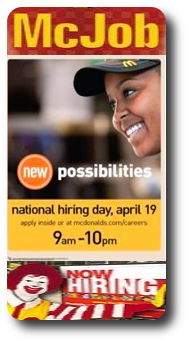
Hiring at McDonald’s – 50,000 McJobs in a day

April 20, 2011

McDonald’s announced April 19, 2011 as National Hiring Day in the U.S. McDonald’s has 14,000 restaurants in the U.S. and has 650,000 employees. On April 19, this figure will be 700,000 employees i.e. roughly four people per restaurant. (McDonald’s has around 32000 restaurants globally in 117 countries.)McJobs at McDonalds Hiring

As per the plan, McDonald’s will hire 50,000 new employees in various part-time and full-time positions at crew and management levels. The starting wage will typically be more than $8 an hour. Restaurant managers can earn up to $50,000 a year. McDonald’s was also recently selected by Working Mother magazine as one of the best companies in the country for hourly employees.

McJobs – Changing Perception

Oxford English Dictionary defines McJobs as “an unstimulating, low-paid job with few prospects.” McDonald’s is looking to change the perception of the term McJobs with this effort and teaching its workers important skills.

Around 75% of restaurant managers and 40% of corporate employees at McDonald’s started as restaurant crew members. And 50 percent of McDonald’s franchise owners started working as crew members. This should be great news for those who see it as a first step to a better career later, either within or outside the company. This should also be good news for the American economy where the national US unemployment rate is around 8.8 percent.

McDonald’s urges applicants to apply in person at their local restaurant or online. The biggest hiring initiative in company history comes in the wake of growing number of 24-hour stores.

«‹ 2 3 4 5›»

Recent Posts

  • Operational Secrecy – Innovating in “secret”
  • Boomerang CEOs aka Founder Recall
  • How companies listen to their customers
  • Developers as Happiness Engineers
  • Management Gurus and what they are known for

Recent Comments

  • MKJ on How to write a case study?

Categories

  • Articles
  • Business Ethics
  • Business Strategy
  • Dell
  • Entry Strategy
  • GE
  • HP
  • HR Case Studies (HRM)
  • IBM
  • Innovation Management
  • IT Cases
  • Jack Welch
  • Leadership and Entrepreneurship
  • Marketing Management
  • Mergers and Acquisitions
  • Nokia
  • Oprah Winfrey
  • Retail
  • Supply Chain Management (SCM)
  • SWOT Analysis
  • Tesco
  • Turnaround Strategy
  • Uncategorized
Business & Management Case Studies
  • Privacy Policy
  • FAQ
  • RSS
  • About
  • Helpdesk
© Business & Management Case Studies 2026

↑ Back to top