Business & Management Case Studies
  • Case Studies
  • Articles
  • About
  • FAQ

How are successful innovators different?

April 11, 2011

A recent study (400 companies) on global innovation by Booz & Company found that the most innovative companies (seven out of 10 top innovators) were not necessarily the biggest spenders on innovation.

The top 10 innovators are:

  1. Apple
  2. Google
  3. 3M
  4. GE
  5. Toyota
  6. Microsoft
  7. P&G
  8. IBM
  9. Samsung
  10. Intel

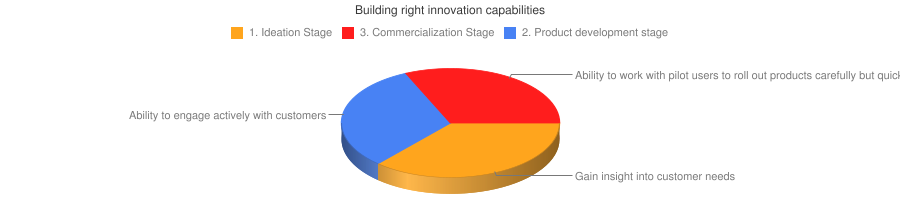
Building right innovation capabilities not mere Spending

What matters is the ability to develop the correct innovation capabilities. These capabilities should match with the overall business strategy.

Building right innovation capabilities

Tesco’s mistakes in US – Not understanding the American Customer

March 22, 2011

In early 2006, Tesco plc decided to enter the US market with convenience stores (Fresh & Easy Neighborhood Markets) to be launched by 2007. Tesco had been studying the American market for two decades and its entry was long time coming. Though the company is not faring that well (currently loss making and is not predicted to break even until the financial year 2012), it hopes to turnaround sooner than later.

The following are some of Tesco’s mistakes in the US market:

The American way of shopping – Car culture and weekly shopping expeditions

Tesco opened stores in California, Nevada and Arizona offering about 4000 fresh products. But US customers do not shop daily, particularly in California where families shopped weekly in cars. Tesco on the other hand wants to cater to shoppers who have less time and want fresh and healthy food.

Competition not only from US super chains

Tesco was also facing tough competition from Japanese owned supermarket chain FamilyMart which had started two premium convenience stores under the banner  Famima in California and had big expansion plans. The Japanese store offered a new community lifestyle experience along with services like banking, stationary department and also Japanese delicacies like sushi, noodles etc. Its imported groceries also cost less than Tesco.

No Discount Coupons

The American customer wants to try something before making a final decision on buying. Even discounts or taste samples help in finalizing a deal. But Tesco removed discount coupons.

No Promotional Fliers

There is less loyalty in the US market with the American consumer shifting loyalties based on weekly/daily special promotional offers. Tesco assumed that like British consumers who would not switch loyalties easily, the Americans would follow suit. A focus group found that Tesco was not sending fliers promoting the latest special offers.

Good Effort but No Learning

When Tesco entered US, it did not go unprepared into the American market. It sent around 50 to 60 British executives to live with California families to discover the products they bought and the food they ate. But with Tesco’s dropping profits it seemed they did not learn much into the American way of buying.

Tesco did not partner with a US retailer when entering the US market and also intended to use its own proprietary distribution system.

McDonald’s versus Subway – The Sandwich Hamburger battle

March 10, 2011

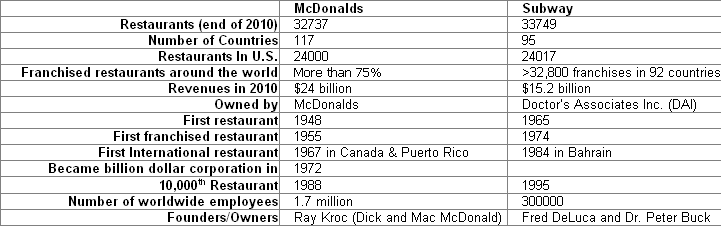
In March 2011, sandwich chain Subway surpassed the world’s largest hamburger chain, Mcdonald’s in terms of the number of stores globally. In 2002, around nine years ago, Subway had already surpassed McDonald’s in number of stores in the U.S. However, McDonald’s still rules in terms of revenue with $24.1 billion, as compared with $15.2 billion for Subway last year. Read McDonald’s International Innovations

Subway – Rapid growth strategy – opening outlets in non-traditional locations

Subway has opened around 8000 outlets in non-traditional and unusual locations. E.g. in Automobile showrooms, Goodwill stores, high schools, zoos, appliance stores, ferry terminals, riverboats, and even a church. In China it has around 200 stores and has plans to expand it to around 500. Subway has competitive advantage over other chain restaurants as it costs less for it to open and operate a smaller format store.

McDonald’s Versus Subway
McDonalds versus Subway comparison chart View image in full size

Rise Mahindra Rise – Brand Makeover and Positioning

January 18, 2011

Re-branding Mahindra with a New tag-line

Around 13 years ago, Mahindra & Mahindra (M&M) defined its core purpose inspired by Akio Morita, founder of Sony Corporation. Its tag-line read – “Indians are second to none in the world.” While Sony Corporation represented Japan as the best in the world with its world-class products, M&M wanted to do the same with its products for India.
Mahindra's New Brand Makeover Tagline - Rise

With this core purpose and global ambitions, M&M grew rapidly to a $7.1-billion automobiles-to-IT conglomerate since its founding in 1945. With businesses expanding to newer geographies (Mahindra Group has a presence in 79 countries around the world), 10 per cent of M&M’s workforce comprised of non-Indian employees. The tag-line no longer suited a global multinational company with customers all around the world. Mahindra chose to reposition itself based on employee, consumer and customer feedback and hired StrawberryFrog, a New York-based global advertising agency.

New branding called Rise

M&M had never communicated through a single brand umbrella across its segments such as aerospace, automotive, farm equipment, IT and logistics. The need for one brand voice spanning geographies was evident in capturing global markets. After a nine month search the company chose ‘Rise’ which the group’s vice chairman and managing director Anand Mahindra believes is not a word but a rallying cry that will give an opportunity to become tomorrow’s company. The word ‘Rise’ was chosen after customers around the world expressed a common desire to rise and to succeed.

Spirit of ‘Rise’ – Three Brand Pillars

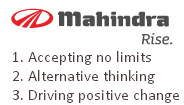
Rise is based on three brand pillars –

  1. Accepting no limits
  2. Alternative thinking
  3. Driving positive change

By incorporating Rise into its performance management systems, M&M wants to allow its employees to perform better and succeed. The company plans to spend about Rs 120 crore over three years to promote its new brand positioning.

Mercadona – Innovative HR Practices for better store performance

January 17, 2011

Mercadona, a Spanish supermarket chain is not only committed to offering the lowest prices but also personalized customer service. For over a decade, Mercadona has had steady profits and do so for more than a decade. In 2008 it had 1,210 supermarkets.

In 2008, its performance, operation-wise was superior to other Spanish chains and also foreign chains in the business. It’s sales per square foot was 60 percent higher than French retail chain Carrefour and twice more than an average U.S. supermarket. But all this was not achieved by neglecting its employees or cutting labor costs. In fact, Mercadona employees received more wages and training (20 times more training) than what the average American retailer offers. An indication of better employee productivity is the 18% higher sales per employee than other comparable Spanish chains (50% higher than U.S. chains).

HR Secrets of Success

Stable labor policy – Permanent contracts and Better pay

While Spain and Spanish retail chains are known as leaders in offering temporary contracts to employees, Mercadona is recognized for its stable labor policy. It offers only permanent contracts to its employees from the start. It also offers average pay better than the rest of the industry sector.

Employee Bonus

In 2008, when sales growth slowed down Mercadona still gave a EUR 190 million bonus to its staff, 19% more than a year earlier. CEO Juan Roig acknowledged his employees contribution and hard work and that they could not be solely responsible for the downturn. For promotions, employee coordinators assess employees based on a series of parameters and on their own judgement.

Additional month of maternity leave

Newspaper El País reported that Mercadona extends the legal four months of maternity leave to five months but on a discretionary basis and also based on certain conditions like foregoing pay rise or bonus.

Better workplaces

A few of Mercadona locations have nurseries to look after children and also free services like day care, food etc.

Employee Training

Mercadona provides an average of 60 hours of training per worker per year with all executives trained within the company. In 2008, Mercadona employees received more training (20 times more training) than what the average American retailer offers. In 2008, Mercadona spent €5,000 for each new store employee and four weeks in training time compared to just seven hours in the U.S.

Cross-training and Predictable Schedules

By cross-training employees, Mercadona ensures that employee productivity is not related only to store traffic. A store cleaner is trained on a cash register which he/she can operate during more traffic times, while a cashier can stock products on the shelf during less-traffic time. As a result, Mercadona is able to provide monthly schedules to their employees as compared to the U.S. chains which find it very difficult to even provide a weekly schedule to its full-time employees. This (stable hours and salaries) has resulted in Mercadona having only a 3.8 percent turnover rate with over 85% full-time employees.

No work on Sundays

Mercadona supermarkets do not open on Sundays and not even in tourist resorts to ensure work-life balance.

Ensuring employee productivity

To avoid employees coming late to work, Mercadona managers only recruit employees who stay no more than 10 minutes walking distance from the stores.

Department Specialists and Prescription Instructors

Mercadona stocks only the highest-quality and affordable products. A customer can walk up to a department specialist in the store and ask for advice on buying a particular product. The department specialists know everything about the products the store stocks. Any product changes are in the knowledge of the specialist. By stocking lesser products, the specialist has less information to remember. Field employees known as ‘prescription instructors’ constantly visit stores in their area to know what customers were saying about Mercadona’s products and service. Such information is conveyed back and forth in the chain to the management and to the suppliers as well.

To Mercadona, before it thinks about impact on the profits it always thinks about society, its suppliers, its customers and also its employees.

Reverse Innovation – Definition and Examples

May 31, 2010

What is Reverse Innovation?

Reverse Innovation (also called frugal innovation or trickle-up innovation) is the strategy of innovating in emerging (or developing) markets and then distributing/marketing these innovations in developed markets. Many companies are developing products in emerging countries like China and India and then distributing them globally.

Who coined or introduced the ‘reverse innovation’ concept?

Vijay Govindarajan. He is the Earl C. Daum 1924 Professor of International Business at the Tuck School of Business and founding director of Tuck’s Center for Global Leadership.

Examples of Reverse Innovation:

Tata Motors – Tata Nano

While companies like Ford set up its global automobile platform in India and catered to the niche premium segments in India, Tata introduced the Tata Nano for the price conscious consumer in India in 2009. Tata plans to launch Tata Nano in Europe and U.S. subsequently.

GE – GE MAC 800

GE’s innovation on the GE MAC 400 to build a portable low-cost ECG machine to cater to the rural population who cannot afford expensive health care was launched as an improved version a year later in 2009, in U.S. as MAC 800.

Procter and Gamble (P&G) – Vicks Honey Cough – Honey-based cold remedy

P&G’s (Vicks Honey Cough) honey-based cold remedy developed in Mexico found success in European and the United States market.

Nestle – Low-cost, low-fat dried noodles

Nestle’s Maggi brand – Low-cost, low-fat dried noodles developed for rural India and Pakistan found a market in Australia and New Zealand as a healthy and budget-friendly alternative.

Xerox – Innovation Managers

Xerox has employed two researchers who will look for inventions and products from Indian start-ups that Xerox can use for North America. The company calls them as ‘innovation managers’

Microsoft – Starter Edition

Microsoft is using its Starter edition’s (targeted at not so technically savvy customers in poor countries and with low-end personal computers) simplified help menu and videos into future U.S. editions of its Windows operating system.

Nokia – New business models

Nokia’s classified ads in Kenya are being tested as new business models. Nokia also incorporated new features in its devices meant for U.S. customers after observing phone sharing in Ghana

Hewlett-Packard (HP) – Research Labs in India

HP intends to use its research lab to adapt Web-interface applications for mobile phones in Asia and Africa to other developed markets.

Godrej – Chotukool Refrigerator

In February 2010, Godrej Group’s appliances division, Godrej & Boyce Manufacturing Co Ltd test-marketed a low-cost (dubbed the world’s lowest-priced model at Rs 3,250) refrigerator targeted mainly at rural areas and poor customers in India. The product runs without a compressor on a battery and cooling chips. The company wants to use a community-led distribution model (as an alternative channel of distribution) to push for product growth.

Tata – Swacch – World’s cheapest water purifier

Swacch means clean in Hindi. Tata launched the water purifier – Tata Swacch targeting the rural market in India with the cheapest water purifier in the market. The product does not require running water, power or boiling and uses paddy husk ash as a filter. It also uses silver nanotechnology. It can give purified water enough to provide a family of five drinking water for a year. The company feels it will open a whole new market.

Pepsico – Kurkure and Aliva

Pepsi is planning to give developed markets (particularly West Asia) a taste of its salted snack Kurkure (and also another snack Aliva). The product enjoys huge success in India and has become a Rs 700 crore brand within a decade of its launch. The success is attributed to product innovation and a good marketing strategy. E.g. Made from corn, rice and gram flour, zero per cent trans fats and no cholesterol, Rs-3 small packs for pushing sales in the lower-tier towns.

Bharat Forge – Maintenance Management Practice

The best practices group at Bharat Forge, a large Indian manufacturer and exporter of automobile components implemented a maintenance management practice it developed in India (developed over 15 to 18 years) in its units it acquired in countries (known for sophisticated engineering) in Germany, Sweden and U.S. The maintenance management process focused on minimizing downtime during machine maintenance and has an advanced information system that predicts problems before they happen. Consequently, Bharat Forge plants globally are very efficient and have an average down time of less than 10 per cent.

KFC – Taco Bell – Yum! Restaurants

KFC test-marketed Krushers, a range of chilled drinks in the cold beverages segment in India and Australia and plans to introduce it to other markets. The launch in India was very successful as ‘Krushers’ accounts for 8 per cent of KFC’s beverage sales in India.

Yum! Restaurant’s Tex-Mex chain Taco Bell has one Indian-designed dessert (tortilla filled with melted dark chocolate) on Taco Bell’s US menus.

Husk Power Systems

In India, Husk Power Systems brings light to rural population (over 50,000) by using locally grown rice husks to produce electricity (a unique and cost-effective biomass gasification technology). The company has also received seed capital from Shell foundation in 2009 to scale up operations.

LG – Low-cost Air Conditioners (AC)

South Korea based LG Electronics (LG) planned to develop low-cost air conditioners targeting the middle and lower-middle classes in India. Their goal was to manufacture air conditioners at the cost of air coolers which were very common.

Renault – Logan

Renault designed a low-cost model of its brand Logan for Eastern European markets. It also sold in the Western European markets later on.

Better Place – Smart Grid of Battery charging/Swap terminals

In Israel, Better Place, a electric vehicle (EV) services provider (creates systems and infrastructure that support the use of electric cars), created an intelligent grid of battery-charging terminals and battery-swap stations. The company is now present in many countries like China, Japan, Australia, the U.S., Canada, France and Denmark.

GE India – Steam Turbines

In 2010, GE’s Indian arm tied up with Triveni Engineering and Industries Ltd to manufacture steam turbines in the 30-100MW range. The company plans to then take advantage of lower input costs incurred in manufacturing and export these products to markets in West Asia, Indonesia, Europe and Latin America.

Coca-Cola – eKOCool

Coca-Cola’s Indian arm Hindustan Coca-Cola Beverages introduced eKOCool, a chest cooler operating on solar energy with a capacity to store about 4 dozen 300 ml glass bottles. The innovation also charges a mobile and solar lanterns. Coca-Cola has plans to pilot the innovation in different cities in India and may be it will introduce it in other developed countries as well.

Vodafone – Zoozoos

Vodafone, which operates in more than 30 countries has plans to make its lovable characters – Zoozoos go international. Zoozoos the black-and-white animated creatures, in fact are actual human beings and are quite a rage in India where they were launched in marketing ads and look like aliens and speak an alien language. But the brand message is very clear to people across all age groups. Vodafone has also licensed the characters (and accessories) for retail merchandise across India.

Coca-Cola – Minute Maid’s Pulpy

Minute Maid’s Pulpy was extremely popular in China. It was basically an orange juice with pulp. Coca-Cola introduced it in other countries as well.

Wal-Mart – Small format stores in Mexico

Wal-Mart learnt a lesson in Mexico. Mexican shoppers preferred smaller stores compared to the large format stores Wal-Mart had in the U.S. By 2012, Wal-Mart had 1,250 small stores (Bodegas Aurrera stores) out of 2,138 stores in Mexico. Wal-Mart then opened similar small-format stores in the U.S. and Latin America.

Levi’s – dENiZEN brand imported to the U.S.

In 2010, Levi Strauss & Co. launched its dENiZEN brand jeans in China. This was the company’s first brand launched outside of the United States. With success, the brand quickly spread to India, South Korea, Singapore and Pakistan markets. In July 2011, the brand began selling in the U.S. in Target stores.

Amazon’s BOLD hiring strategy in India

In 2011, Amazon launched a unique hiring programme in India called Building Operations Leadership (BOLD). BOLD is a MBA hiring programme wherein the company takes in students with around two to four years of pre-MBA work experience. This practice differs from its global leadership development programme ‘Pathways’ which requires prior work experience of 7.5 years. With its success, BOLD is being introduced in other markets as well.

P&G’s Connect and Develop Strategy for Innovation

May 24, 2010

Reinventing P&G’s innovation business model

P&G’s old strategy for innovation was based on the invention model where innovation comes from within the company – ‘invent it ourselves’ model. Earlier, innovation at P&G meant building global research facilities and having the best talent in the world develop unique products or inventions. But with the times and technology changing and P&G growing enormously, the old model was not working. P&G needed a new approach.

New innovation model – Connect and Develop

P&G knew that for every researcher it had, there were many others who existed outside the organization. So, rather than sourcing for innovation from within, P&G wanted to identify potentially good ideas throughout the world and apply its own capabilities to them to develop better and cheaper products, faster. The model was called “Connect and Develop”. The new model allowed P&G to shift its centralized approach to a globally networked internal model.

Intel’s Go-to-market Strategy – Tick Tock

April 7, 2010

What is ‘Tick Tock’?

The term ‘Tick Tock’ has been referred to a music group from Puerto Rico, a novel by Dean Koontz, a fictional character in Marvel Comics Universe and even a dance step, but did you know it is the name of Intel’s go-to-market strategy as well.

The global economic downturn hit the semiconductor industry bad. And for a company like Intel which wants to push the latest technology at a rapid pace, it’s go-to-market strategy is even more critical in a downturn.

A few years ago, Intel was lagging behind competitor Advanced Micro Devices (AMD) on multicore technology. Intel wanted to speed up innovation by lowering product development cycles, flawless product road map execution and meeting yearly targets. The company laid put a new plan. They called the new strategy "tick-tock." The company’s CEO, Paul Otellini backed and also led the new strategy.

‘Tick’ refers to various improvements to Intel’s silicon fabrication process. E.g. doubling of the number of transistors on integrated circuits.
‘Tock’ is a more recently quantified process. E.g. architectural upgrades made to the client and server processors.

Glocalization Examples – Think Globally and Act Locally

February 10, 2010

We have heard a lot about globalism versus localism over the years. In order to succeed globally, even the biggest multinationals must think locally. A few examples:

McDonald’s

In the UK, McDonald’s strategy is to listen more to local consumers and then act on it. The company strives to do this around the world. Some if its local favorites around the world include the McItaly burger in Italy, Maharaja Mac in India, the McLobster in Canada, the Ebi Filit-O in Japan.

McDonald’s has novelty items on its menu in Japan like the Teriyaki McBurger with Seaweed Shaker fries, Ebi Filet-O, Croquette Burger and Bacon Potato Pie. McDonald’s signed model Yuri Ebihara (known as Ebi-chan in Japan) to market Ebi Filet-O. Ebi means shrimp in Japanese.

Starbucks

Starbucks is trying out locally designed franchises in stores. The stores are non-Starbucks branded in order to recapture the feel of a local coffee shop, which would otherwise be threatened by the existence of Starbucks in its vicinity.

KFC

To increase visits from local residents, KFC has initiated a five-year plan to upgrade its UK restaurants with new contemporary designs. Designs will be based on ‘look and feel’ of the area and in collaboration with local property developers.

KFC has a vegetarian thali (a mixed meal with rice and cooked vegetables) and Chana Snacker (burger with chickpeas) to cater to vegetarians in India.

Tesco

When Tesco expanded globally in countries such as Thailand, Hungary and the Czech Republic it kept it’s usual name and branding. However, when it entered the United States, it named it’s stores "Fresh & Easy Neighborhood Market".

Nokia

Nokia responded to local customer needs with the introduction of dust-resistant keypad, antislip grip and an inbuilt flash light for Indian rural consumers (specifically targeting truck drivers).

Hindustan Lever Limited (HLL)

HLL identified the importance of rural customers and invented the shampoo sachets priced at almost a rupee which were an instant hit.

Ford

In 1904, Ford was one of the first automotive corporations to go International with the opening of Ford Motor Co. of Canada. Even Henry Ford II had opined that in order to further the growth of its worldwide operations, any purchasing activity should be done after considering the selection of sources of supply not only in its own company but also sources located in other countries. When Ford had set up its first plant outside U.S., in Canada, it gained considerably from the geographic and cultural proximity.

Viacom’s MTV localized strategy with localized programming

MTV has catered to local taste in East Asia in South Korea, China, India and Japan. E.g. MTV broadcasts on two channels with Chinese music in China and Hindi pop in India. Using joint ventures with local partners, channels are branded accordingly as MTV India, MTV Korea, MTV China and MTV Japan and use more local employees with use of local language.

Whirlpool Corporation

Whirlpool Example 1: Domestic appliance maker, Whirlpool incorporated specially designed agitators into its washing machines when it sold them in India. This helped Indian women wash saris without the five-foot long sari getting tangled. Whirlpool formed a joined venture with a local partner to produce the redesigned washing machine to suit local taste and culture. Whirlpool also makes its refrigerators in bright colors like red and blue as many Asian consumers placed their refrigerator in living rooms as a sign of status. Whirlpool believes in standardizing worldwide what it can and adapting what it cannot.

Whirlpool Example 2: As part of Whirlpool’s global strategy, the company wanted to develop products based on consumers tastes and needs. Whirlpool had done extensive research and found that European customers wanted a microwave oven that could brown and crisp food. Whirlpool then designed and introduced the VIP Crispwave which could fry crispy bacon and cook a pizza with a crisp crust. The product was successful in Europe and later launched in U.S. as well.

KFC – Yum! Restaurants

Global chain, KFC has introduced ‘Krushers’ in the cold beverages segment in India. The range of flavors of Krushers has been altered to suit the Indian taste buds.

Subway

The Subway chain does not have beef in its stores in India.

Taco Bell

The Taco Bell menu in India has crunchy potato tacos and extra-spicy burritos filled with paneer (cottage cheese). Taco Bell has hired employees who explain what burritos and quesadillas are to customers in India.

Coca Cola

In 1955, a Coca -Cola advertisement or documentary (almost 20 mins long) referred to as the “Pearl of the Orient” shows Coca-Cola’s popularity in Philippines and how Coke has merged itself into the Philippines economy and culture.

Heinz

In 2010, Heinz plans to launch packaged food products in India which will suit the Indian taste. Heinz, which entered India in 1994, plans to Indianise the flavors offering condiments, juices and snacks to the Indian consumers.

DisneyLand Glocalization in Hong Kong

In 2005, Disneyland was not that successful in Hong Kong with park attendance and growth revenues. Disneyland then made an effort to cater to the local Chinese taste by reducing prices, adapting to local Chinese customs and labor practices and also changed the decors and settings. Glocalization was successfully applied to the theme park in Hong Kong.

Dell’s Advertising in Japan and Asia Pacific regions

Dell did not use its American Steven Jackson (referred to as the Dell Dude) commercials in Japan and other East Asian countries after its Global Brand Management team used localized focus groups to gauge the TV character’s cultural acceptance. The attitude of the American character did not gel well with Japanese social etiquette e.g Know-all display and speaking to strangers without introduction.

Unilever – Marginal Local Adaptation instead of Total Local Adaptation

Unilever took glocalization (local adaptation) to a new level in the 1990s. Instead of adapting products unnecessarily, it adapted products to the local market marginally i.e. the basic product would be fine-tuned instead of expensive total adaptation. E.g. Unilever identified the need for a regional ice cream and was very successful with its Wall’s ice cream adapting it specifically to the Asian taste (different from the rest of the world). In 2000, it had a market share of 41% to Nestle’s 15%.

Another Unilever ice cream brand Asian Delight was very successful in Asia. Unilever’s Bangkok innovation center redesigned the product and adapted it to local taste (coconut ice cream mixed with fruits and vegetables used traditionally in sweets in the region) and packaging (Thai and English on packaging in Thailand).

Italian Luxury Fashion Retail Brands

Luxury retail brands like Bottega Veneta, a unit of PPR, and Canali, an Italian men’s fashion brand launched limited-edition of clutch (Knot India) and closed neck jacket (bandhgala worn by Indian men) specifically for the Indian market.

Nokia’s multi-SIM devices in the Indian market

Nokia launched multi-SIM devices (C1 & C2 series) in India, after it realized its potential. Nokia’s dual-sim phones were introduced late in the market after competitors LG and Samsung also introduced similar mobile phones. Nokia lost out on early market share (to competitors who introduced multi-sim devices early in the market) but planned to introduce it in other emerging markets as well.

Lenovo’s LES Lite stores in the Indian market

Lenovo India has customized LES Lite stores to expand into India’s key tier 3-5 cities/towns. These Lite stores are smaller versions (around 150-250 square feet in size) of Lenovo’s exclusive stores and with lower costs & break-even points.

Gillette’s low cost razor for the Indian market

Gillette introduced the low cost razor ‘Gillette Guard’ priced at about 15 rupees (~$0.33) in the Indian market. Features included easy rinsing (as water is scarce in Indian rural areas) and unique grip design (the way the consumer held the razor).

Piaggio’s Scooter ‘Vespa’ adapted for the Indian market

In 2012, Piaggio & C. S.p.A., the iconic Italian two-wheeler re-entered the Indian market. It adapted its scooter the Vespa to suit the Indian riders and road conditions. E.g. the rear wheel structure was redesigned to facilitate easier tyre changes, the scooter is more efficient than it is in Europe (62km per litre compared to 35 in Europe), increased ground clearance, slimmer design and a lower footboard to give more legroom to Indian women who ride sitting side-saddle in the back seat.

Starbucks India

Starbucks’ first shop in India (opening in October 2012) will have no beef or pork considered taboo by many Indians. The Indian menu has local favorite Chai Tea Latte and the coffee is sourced and roasted locally. Other food items (many meat free options) include baked goods like Konkani Twist or Chatpata Paratha Wrap to adapt its offerings to local vegetarian tastes. There are even separate ovens and counters for vegetarian and non-vegetarian offerings.

SWOT Analysis

January 13, 2010

SWOT is an abbreviation for Strengths, Weaknesses, Opportunities and Threats. SWOT analysis is used for identifying those areas where an organization is strong, where it is weak, the major opportunities the company can explore and the threats. SWOT analysis is a useful tool for assessing the strategic position of a business and its environment. SWOT Analysis helps a company to know where it stands by exploring key issues:

Strengths:

  • What do we do well?
  • How are we better than our competitors?

Weaknesses:

  • What could be done better?
  • What is being done badly?

Opportunities:

  • What are the opportunities that can be exploited?
  • What are the interesting trends?

Threats:

  • What obstacles are being faced?
  • What is the competition doing?
  • Are the specifications for the products or services changing?
  • Is changing technology threatening our business?

SWOT Analysis Example

Sample SWOT Analysis for CONMED Corporation: (for illustration purposes only)

Strengths

  • Global Presence, International Sales approximated 29%, 33%, 35% in 2002, 2003 and 2004 respectively
  • Strong Manufacturing base
  • Clinicians and administrators desiring non-invasive procedures
  • New product introductions
  • Acquisition of key technology like ECOM
  • Certain products like surgical suction tubing and ECG electrodes are commodity products with little differentiation possible
  • Higher incremental costs in 2005 until manufacturing of the acquired products is integrated
  • Weaknesses
    Opportunities
  • Scope for new product or technology introductions
  • Current research focus on reflectance technology products which permits non-invasive analysis of blood oxygen levels in clinical situations
  • Continued cost containment pressures in highly competitive market
  • Change in regulatory environment
  • Patent Litigation risks
  • Threats

    CONMED Corporation (CONMED) (NASDAQ: CNMD) develops and produces medical and surgical procedure instruments.

    «‹ 3 4 5 6›»

    Recent Posts

    • Operational Secrecy – Innovating in “secret”
    • Boomerang CEOs aka Founder Recall
    • How companies listen to their customers
    • Developers as Happiness Engineers
    • Management Gurus and what they are known for

    Recent Comments

    • MKJ on How to write a case study?

    Categories

    • Articles
    • Business Ethics
    • Business Strategy
    • Dell
    • Entry Strategy
    • GE
    • HP
    • HR Case Studies (HRM)
    • IBM
    • Innovation Management
    • IT Cases
    • Jack Welch
    • Leadership and Entrepreneurship
    • Marketing Management
    • Mergers and Acquisitions
    • Nokia
    • Oprah Winfrey
    • Retail
    • Supply Chain Management (SCM)
    • SWOT Analysis
    • Tesco
    • Turnaround Strategy
    • Uncategorized
    Business & Management Case Studies
    • Privacy Policy
    • FAQ
    • RSS
    • About
    • Helpdesk
    © Business & Management Case Studies 2026

    ↑ Back to top