Business & Management Case Studies
  • Case Studies
  • Articles
  • About
  • FAQ

Changing company culture – Examples on cultural transformation movements

March 30, 2012

How do you change the culture of a company? The answer seems simple – Start a movement within the company, restructure the company or start a revolutionary campaign for a new product. Often the change starts within the company and in due course involves the customer and becomes a successful customer movement. The movement is not a mere statement of words. It engages the employees and is more actionable. Movements give everyone in the company a sense of direction and align them with the company goals.

Many companies have started movements/campaigns to boost their company culture. Listed below are a few random examples (some successful and some others not so). Some of the examples may not exactly fit into a companywide culture change/movement and could just be a campaign for a new product or a corporate philosophy or structure. However, it represents a substantial cultural shift, a change in the thinking of the company.

Examples on changing company culture

Company Movement/Campaign
Apple Think Different
Best Buy ‘Results only Work Environment’
Cognizant ‘Three-in-a-box’ and ‘Two-in-a-box’ structure
Dell Low-cost culture and its direct selling distribution model
Facebook Hackathon culture
Ford Fiesta Movement, One Ford Plan
Godrej GoJiyo campaign
GE Six Sigma
Goldman Sachs ‘Leadership Acceleration Initiative’ – an annual six-month program for managing directors around the globe.
Google 20 percent time
Home Depot Operation Career Front
Infosys 18 month initiative in 2007 to reorganize the business into new roles and structures
JCPenney “Fair and Square Every Day” pricing strategy.
Lockheed Martin Full Spectrum Leadership initiative
Mahindra & Mahindra ‘Rise’ brand campaign
Nike Reorganization in 1993
Nokia ‘Amazing Everyday’ campaign
Philips ‘Towards One Philips’, ‘Strategic Conversations’
P&G ‘Organization 2005’ program in July 1999
Toyota The Toyota Way

A brand extension mistake by Harley Davidson

March 12, 2012

An iconic cult brand

Harley Davidson (H-D), the American motorcycle manufacturer has a loyal brand following not only in the U.S. but also in many countries across the globe. The motorcycle’s distinctive design and exhaust note has given rise to many loyal brand communities that are active in clubs, events, and even a museum. Such is the power of the cult iconic brand that just licensing of the Harley-Davidson logo amounts to approx. 5% of the company’s net revenues. In 2007, an Interbrand report suggested that the brand name ‘Harley-Davidson’ had a market value of $7.72 billion, which was 131 times more than the book value of $59 million.

Long-term relationships with the customers

In 1983, the Harley Owners Group (HOG) was formed to capitalize on the brand following and create long-term relationships with the customers. The aim was to promote a lifestyle along with the product. By 2010, HOG became one of the largest owners groups in the world. Globally, it had about 1.4 million members with about 40 bike models. Harley Davidson bikes were called “Hogs” and in 2006, even its ticker symbol ‘HDI’ was changed to ‘HOG’ on the New York Stock Exchange. The company’s attempt to trademark the name however failed as it became a common term for heavyweight motorcycles.

Harley Davidson – Brand Values

Freedom – Go wherever you want to, whenever you want to.
Authenticity – Noted for the tradition of heavy customization, Oldest and quality name in manufacturing bikes.
Community Building– HOG has 1.4 million members, Ride Planner to plan trips, H-D Photo Center for posting photos of memorable trips.
Rituals – Community festivals and monthly or annual rides/events are conducted regularly, buttons and pins from an activity/event are worn on jackets.
Masculinity – Unique sound of the exhaust, association with icons in films.
Toughness – Rugged heavy design and look of the bikes.

A cult iconic brand extension

In the 1990s, everyone wanted custom Harley bikes. It had become the symbol of a generation of achievers and acquired cult status. A Harley bike meant toughness, masculinity, freedom and raw power (low-end torque) though it did not come with the latest technology or high speed. The company’s stock prices soared. Harley bike owners even had logo or bike tattoos done. Owners of H-D bikes did not just buy a product. They bought a whole set of shared values, a lifestyle, a heritage. The company wanted to capitalize on the brand. It introduced a range of accessories to match the bike. A chain of retail shops sold H-D branded merchandise like T-shirts, jackets, caps, gloves, helmets key chains, socks, ornaments etc.

Harley Davidson - Perfume Brand Extension Failure

A brand over-extension

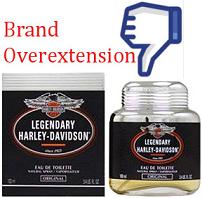
While motorbike apparel (Motorclothes® merchandise) and ornaments probably matched the Harley Davidson cult heritage brand, the company had lost focus. In the 1990s, it extended the brand too far. It introduced products like wine coolers, aftershave and perfumes. Even the loyal fans did not like the idea, as it did not resonate with the tough brand identity. The company was clearly not focusing on what it knew best – building strong bikes. Customers wanted strong bikes and accessories that complimented the brand, but ties and infant clothes went too far. Activities like cruise biking were good initiatives by the company to involve the customer and enhance brand loyalty. However, Perfumes and wine coolers were eroding the mystery of the H-D brand. After strong criticism from the loyal customers, the company pulled of many inappropriate products. H-D had learnt a branding lesson. More products did not mean more revenue and overextending the brand meant a short-term focus.

Pepsi’s Crystal Fiasco

March 7, 2012

Clear = Purity and health

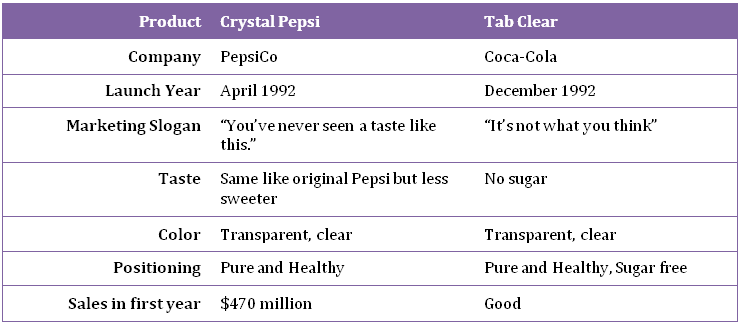
In 1992, Pepsi launched a new colorless soda called “Crystal Pepsi”. Consumers wanted purity and Pepsi believed a clear soda without color was the answer as it signified purity and health. Pepsi marketed the new formula as caffeine-free, pure alternative to the classic reddish brown normal colas. At the time, soda products were gathering a negative unhealthy image and consumers preferred more healthy alternatives like natural juices.

Unsuccessful products - Crystal Pepsi and Clear TaB

Crystal Pepsi = Pepsi = Confused customer

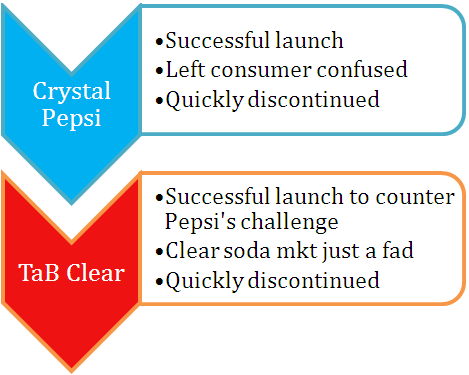
The market already had a long list of colas, diet colas, caffeine colas, among others and Pepsi believed why not have another cola. After test marketing it in a few areas and receiving a fair response, Pepsi launched Crystal Pepsi in April 1992. The marketing slogan for Crystal Pepsi was “You’ve never seen a taste like this.”

Though initial sales were promising, consumers were not happy with the taste. Sales (around $470 million in the first year) were probably more out of curiosity than anything else was. It was similar in taste to the original Pepsi. Other colorless sodas like 7UP and Sprite had a citrus or lemon flavor. Customers were not sure how Crystal Pepsi was supposed to taste. Was it supposed to taste like Pepsi? Or not? If it was supposed to taste like original Pepsi, why was it more expensive?

Clear Competition

Pepsi had failed to position the product correctly. In the meantime, Coca-Cola launched its own transparent product called “TaB Clear” in December 1992. Coca-Cola positioned the product as sugar/calorie free ‘diet’ product. On the other hand, Crystal Pepsi had sugar content and failed to find the right fit in the diet category.

Crystal clear no more

After about a year since launch, Pepsi decided to halt the production of Crystal Pepsi. Pepsi began working on a new formula. In 1994, Pepsi launched another variant. This time it called the product just “Crystal” minus the Pepsi. However, Pepsi failed again and scrapped the idea of a clear cola. Even Coke failed with the TaB Clear. The clear soda market proved to be just a fad.

Lesson Learnt

Pepsi was successful with Diet Pepsi. However, this success did not guarantee success with Crystal Pepsi. Even the re-launch as Crystal (minus the Pepsi in the name) was unsuccessful. Perhaps it had identified and was trying to fill a market gap, which was unnecessary.

Crystal Pepsi versus Coke's Clear TaB

To create or compete

March 6, 2012

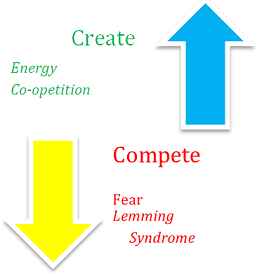
To create or to compete. Many companies mistake one for the other. When a company creates, it implies it has found new products/services or new methods of buying/selling. These new products or methods are hard for the competition to attempt. When one competes, a company targets the same markets and consumers as the competition does and most likely, with the same methods, the competing companies use. Following competition, learning, and adapting from them is another thing. However, blindly following the competition and copying their every move leads to decreasing margins as the company suffers from the ‘lemming syndrome’. In fact, companies can make the competition work for them instead of being fearful that they will take away the business.

To create or compete

First to create

Coke was the first cola company in the market and that brand heritage, taste and history has been its success. Dominos was the first to home deliver pizzas and has been successful since then. FedEx was the first to introduce overnight express delivery and has been successful globally.

Copying a competitor can backfire

In the 1980s, Pepsi was quickly catching up with Coca-Cola and winning new customers. Pepsi and even Coke’s own brands like Fanta, Sprite and Diet Coke were challenging its number one status. Coke narrowed down the problem to taste as Diet Coke was doing well in third position and was similar in taste to rival Pepsi. In 1985, after extensive market research tests, Coke launched the New Coke with a new formula and taste (more like Pepsi). It even stopped the production of the original Coke. Consumers were not very happy and the move backfired. Coke had underestimated its brand power and the heritage its brand stood for. Coke had to reinstate the classic Coke and learnt a valuable lesson of consumer perception of its brand rather than a mere competition of products.

Copying a competitor’s move does not always backfire

In 2009, PepsiCo acquired its bottlers. This gave it more control over distribution and product placement at retailers. PepsiCo was very successful. However, the following year, Coca-Cola copied the move with its bottlers in North America and gained back the advantage.

You can create and still fail

Sometimes a company can create but is still unsuccessful. E.g., Sony’s Betamax video recorders failed in spite of better quality Betamax technology over VHS (video home system) format. Sony’s inability to license the technology and widespread use of the VHS format contributed to the downfall.

Currently creation is the need of the hour but perhaps herd mentality of competing is winning with risks getting riskier.

Repeatability model for success

February 27, 2012

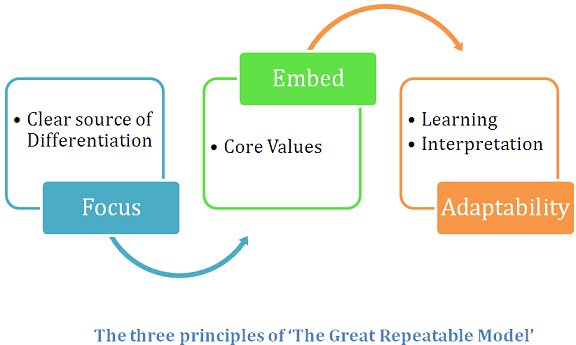
In their book, Repeatability: Build Enduring Businesses for a World of Constant Change authors Chris Zook and James Allen, outline design principles of successful businesses. These principles were termed the “Great Repeatable Model”. Companies that adopt these principles can repeat their success, hence the name repeatable model. According to the authors, there are three key principles:

  1. Principle of Focus
  2. Principle of Embeddedness
  3. Principle of Adaptability

Three Principles of the Great Repeatable Model

As per the first principle, companies need to identify how they differentiate in comparison to others. Faced with new markets or changes, identification of a clear source of differentiation gives the company an edge over others. Many companies believe they have differentiation, but customers might disagree. At this point, a genuine leader can identify the gaps to fill in and remodel to deliver things differently.

E.g., Apple was able to repeat its success with the iPod, iPhone and the iPad. Apple provides its customers with a high quality product that has excellent design. All its products aim at superior user experience. With iTunes integration, a customer is at ease with the entire range of products.

The second principle emphasizes core values that a company must strive for and embed it into their culture. A leader must drive these core values and be in-sync with the employees. The core values must drive all major decisions the company makes. A customer must identify with these core values when he/she interfaces with the product or service provided by the company.

E.g., Google has been successful with many products like Search, Gmail and many others. Google’s core values – focus on the user and rest will follow, fast is better than slow or great is not just good enough. A customer identifies these core values in each of Google’s products and company founders communicate and live these values as well.

The third principle is straightforward. A company has to adapt to changes. With failure or competitors catching up, it has to question its assumptions and adapt its model. It is essential therefore that a company learns and the rate at which it learns (or measures its product or service quality and performance). However, learning is not enough. A correct interpretation of the learning helps in repeating success.

E.g., Zara the world’s leading fashion retailer deployed a new process to deliver shipment to its stores (more than 1500) globally from its two warehouses in Spain by relying on operations research techniques. Zara was able to build an innovative and highly responsive design, production and distribution structure. By determining the best shipment quantities to deliver, it was able to increase its sales by 3 to 4% in 2007 and 2008.

Apple’s Four Quadrant product grid

February 26, 2012

Complexity distorts information flow and decelerates clear decision-making. Any decision made in the face of complex operations, unnecessary product types or models are increasingly incoherent. Companies that do well have a sense of clarity and focus with less complex operations and product lineups.

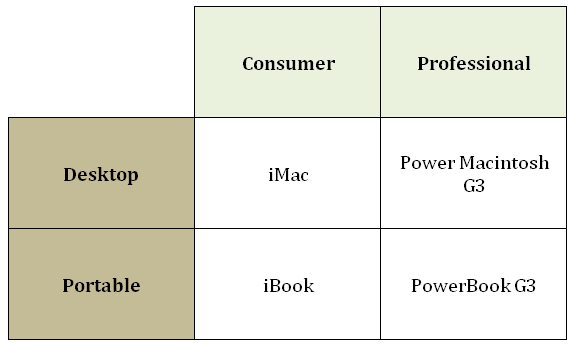
Companies whose business models are simple can replicate their successes repeatedly. Apple’s co-founder Steven Paul Jobs (Steve Jobs) realized this quite early. At the MacWorld Expo in 1998, Steve revealed a four-quadrant product grid. Upon his return to Apple, Steve toured the company and found that there were far too many teams working on the Mac. Each team had different names and viewpoint of the Mac in mind and lacked coherence. He came up with the idea of a simple four-quadrant grid with two rows labeled as ‘Consumer’, ‘Professional’, and the columns as ‘Portable’ and ‘Desktop’. This way Apple engineers and managers had to focus on only four core product areas and the company could deploy the best engineers in the right area. Additionally, there would be no product or resource overlap. Even the naming convention seems simple e.g. ‘i’ in consumer products and ‘Power/Mac’ in professional products.

Steve Jobs four-quadrant product grid

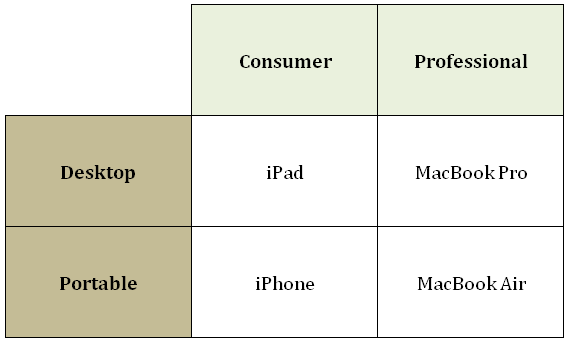
A newer grid today might look like this:

Steve Jobs four-quadrant product grid

Recent examples of companies reducing product complexity are Google, HP and MTV. Google has retired many products. In a recent conference call in Feb 2012, HP’s CEO Meg Whitman emphasized the need to trim down its many products models, SKUs and configurations and to remove unnecessary complexity from designing to manufacture and delivering products. MTV India, the music channel is shifting its focus back on music and reducing non-music format shows.

Reinventing jcpenney

February 15, 2012

No deep discounts

Revitalizing stores with increased emphasis on interiors, product display and merchandising is a common strategy to lure shoppers. Many retail stores focus on expanding the range and diversity of goods on display – to provide them in every possible color and size, at the right time. Selling at discounted prices is another common strategy employed by retailers.

However, J.C. Penny (founded in 1902, now jcpenney) seems to be thinking different. Instead of using deep discount sales to attract customers, it launched its simple new “Fair and Square Every Day” pricing strategy. The basis for its new strategy is the realization that less than 1% of everything sold at its stores sells at full price. More than three-fourth sells at a 50% discount.

New CEO, new logo, new spokesperson and a new pricing strategy

According to Forbes magazine, J.C. Penney, under the leadership of CEO – Ron Johnson, will be the most interesting retailer of 2012. Before joining as CEO, Ron Johnson put together Apple’s retail strategy (the ‘Genius bar’ was one of his ideas). Ron joined J.C. Penney in November 2011 and went on to describe it as the single greatest opportunity in American retailing. In February 2012, Ron began a complete transformation process at jcpenney. To distinguishing itself from other retailers and resonate with American shoppers, the company designed a new logo in colors of the American Flag. The new square shaped logo reflects the new pricing strategy called “Fair and Square”. By August 2012, stores will have new merchandise and presentations. Every month the company plans to open two to three new shops until 2015. The company also hired talk show host Ellen DeGeneres as its spokesperson.

The new pricing strategy – Not EDLP

Jcpenney has a new “Fair and Square Every Day” pricing strategy. The idea is to keep pricing simple and build long-term relationships with customers. The store will have only three simple prices – Every Day (red stickers), Month Long Value (for theme sales, white stickers) and Best Prices (for clearance items). All prices will be rounded off to ‘0’ instead of ‘.95’ or ‘0.55’. The company will cut down on promotion budget and promotions from 590 a year to 12. As per the new pricing strategy, there will be no discount gimmicks and prices reduced before the products are placed on the shelf. The customers do not have to wait for reduced prices (like in Wal-Mart’s EDLP) and can get a low price every day.

The new jcpenney

  • No constant price discounting. Reduced prices before product is placed on shelf. Almost 40 percent cut in retail prices with prices in flat dollar amounts.
  • Promotions down from 590 to 12 a year
  • Promotion budget cut from $2 million per promotion to $80 million a month promoting all products.
  • Best Price Fridays – two clearance sales, on the first and third Fridays of the month.
  • Each store will have a ‘Town Square’ (on the lines of Apple’s Genius bar) to provide complimentary services and free items. The Town Square will be centrally located (customers can see products on the way through).
  • Make stores more appealing, highlight brand names and gain more.
  • There will be as many as 100 stores within a store to accommodate branded or thematic stores.
  • Trim private-label lines and celebrity lines. CEO believes in brand power.
  • Company motto – Let customers to shop on their terms, not ours.

How companies differentiate from competitors?

February 13, 2012

The goal of any company selling a product or service is differentiation. A company pitches its unique selling proposition that is going to be most advantageous for it. Successful differentiation requires a good product or service and customer insight (customers’ perception of a company’s product and those of competitors). Setting its products or service apart from its competitors is necessary to create preference and loyalty.

Here are a few examples on how companies differentiate from competitors:

Apple – Appealing Design, robust software
Hands-on software, simple product design and unified iTunes ecosystem.

BMW – Ultimate driving machine
“The ultimate driving machine”. It gives many professional reviews on how BMW’s drive its ergonomic design, maneuverability, non-overweight engine.

Holstee – Powerful mission statement
A mission statement can set you apart from competitors and can be enough to sell products. Quite literally, this is what happened in Holstee’s case. Holstee, a New York–based company, sells eco-friendly clothing and accessories. Its mission statement different from the usual was labeled as the Holstee manifesto. It became a best seller and was viewed more than 50 million times and translated into 12 languages. The mission statement printed on recycled paper sold at $25 a poster.

J. C. Penney – Simple pricing strategy
J. C. Penney, the 110-year old department store, has a new “Fair and Square Every Day” pricing strategy. The store’s differentiation strategy is to keep pricing simple and build long-term relationships with customers. The store will have only three simple prices – Every Day, Month Long Value and Best Prices.

Nike – Brand Power
Brand power, strong bonding with top athletes (Michael Jordan, Brazilian national soccer team), and performance-focused product design. Nike produces products that are customers recognize to be of high value with exclusive features. Nike is also known to use guerrilla marketing to publicize its products e.g. Nike’s use of small Gone Running signs in amusing situations.

Qantas – Safety record
Qantas, Australia’s largest domestic and international airline distinguishes itself as the second oldest airline in the world (founded in 1920). Its reliability and immaculate safety record are main selling point. The company identifies safety as its first priority and prides itself on its safety first culture.

Singapore Air – Distinctive services at premium costs
Distinctive premium services on long-haul business flights at practical costs. It was the first to introduce many services like video-on-demand, hot scented towels, hot meals etc. It uses a young fleet of aircrafts and its well-dressed ‘Singapore Girl’ cabin crew is a brand icon.

Tetra Pak – Innovation that adds value and inspires customers
Products that add value (eliminating need for refrigeration), save costs (easy logistics) and help customers increase production (e.g. laminated material which aids high-volume dairy operations)

Virgin Atlantic
Funky fun and good value. In 2009, Virgin Atlantic was the first commercial airline to use bio-fuel.

Innovation Dilemma – 10 recommendations

February 9, 2012

Many global companies suffer from the absence of strong innovation. Here are ten recommendations on how to innovate to create competitive advantage for managers seeking to build products and services globally.

  1. Do not innovate. Build a product or service. Innovation happens.
  2. A strategy to make products to have eureka moments will not succeed. Instead focus on building the product or service and a eureka moment might just happen.

  3. Do not fear failure. Discuss it.
  4. Apple’s Apple III launched in 1980 was a commercial failure. General Electric Co. (GE) shares its best practices across its many units and officially discusses failures as well.

  5. Be aware of market, product and technological developments.
  6. Orkut, the social network by Google did not catch up with Facebook applications and platform.

  7. Patience is rewarding.
  8. Dennis Crowley, founder of Foursquare took about five years to come up with the idea and build the service.

  9. Why, what and How are your best friends.
  10. What are you going to build? Why are you going to build it and how are you going to achieve it? Any manager should ask these critical questions before venturing into product development.

  11. Learn, unlearn and relearn.
  12. In 2000, Virgin Airways invested $67 million in J2000 seats. Customers were unhappy with the discomfort caused by the seats and the investment was unsuccessful. However, Virgin did not give up. It invested $127 million to overhaul of the airline’s upper-class seats. In 2003, the newer seats were successful wherein flight attendants would flip over the back and seat cushions to make the bed.

  13. Analyze but do not paralyze. The customer may not know what he/she wants.
  14. Steve Jobs was not a big fan of consumer research. According to him, it is not the consumers’ job to know what they want. He believed, to build a great product, think like a consumer of the future not the past. Attention to details can destroy as much value as it creates.

  15. Negate negativity. Have a good budget.
  16. A short-term vision may hamper innovation. Negativity destroys much value.

  17. Imagine the unimagined.
  18. Eat well, stay healthy and more importantly sleep well (dreaming is important!).

Nissan Production Way

November 22, 2011

Toyota invented the Toyota Production System (TPS) and in 1994, Nissan developed the Nissan Production Way or NPW to outline its synchronized production philosophy. The idea was to improve the company’s productivity and effectiveness and have a global standard production system. So essentially, manufacture according to the real consumer order, thus coordinating all operations and materials.

After the Renault and Nissan alliance took place, Renault embraced the NPW in its plants to produce each other’s automobiles. Renault increased its productivity and decreased its defective parts percentage as a result.

Basic Principles of Nissan Production Way – Two Never Ending

  • Never ending synchronization with the customer – Synchronization of Quality, Cost (eliminate waste) and Time (reduced lead-time, on time delivery).

    Nissan uses the term “Douki-seisan” – sequenced and simultaneous/synchronized production to define the whole range of its highly productive NPW. The douki seisan concept helps cut lead-time across the supply chain, and begins & ends with the customer. After a customer places an order with a dealer, there has to be synchronization between the manufacturer, the supplier and the dealer with an efficient process flow without any disruptions.
  • Never ending quests to identify problems and put in place solutions – Identify gaps between desired manufacturing state and present manufacturing settings. Nissan uses the term “Genba kanri” – shop floor management to solve problems where they occur most (in the shop floor) and make improvements.

How the Nissan Production Way works

Here is a video from Nissan on its Nissan Production Way –

‹ 1 2 3 4›»

Recent Posts

  • Operational Secrecy – Innovating in “secret”
  • Boomerang CEOs aka Founder Recall
  • How companies listen to their customers
  • Developers as Happiness Engineers
  • Management Gurus and what they are known for

Recent Comments

  • MKJ on How to write a case study?

Categories

  • Articles
  • Business Ethics
  • Business Strategy
  • Dell
  • Entry Strategy
  • GE
  • HP
  • HR Case Studies (HRM)
  • IBM
  • Innovation Management
  • IT Cases
  • Jack Welch
  • Leadership and Entrepreneurship
  • Marketing Management
  • Mergers and Acquisitions
  • Nokia
  • Oprah Winfrey
  • Retail
  • Supply Chain Management (SCM)
  • SWOT Analysis
  • Tesco
  • Turnaround Strategy
  • Uncategorized
Business & Management Case Studies
  • Privacy Policy
  • FAQ
  • RSS
  • About
  • Helpdesk
© Business & Management Case Studies 2026

↑ Back to top